Since the early days of the COVID-19 shutdowns began to help everyone understand that life would be different for quite some time, Project REAL started adjusting our programming to meet the needs of young Nevadans. That work began with an immediate distribution of our entire Play By the Rules stock to families in underserved communities through a variety of partnerships with other nonprofits. The goal was to provide families with a tool that could help students see the big picture when it came to their choices within the law at a time when they had a lot of pent up energy, and provide we did: Over 3,000 families received those books by the end of April 2020.
Since then, we’ve split our time between developing new resources directly in response to the pandemic, continuing new resource development that we had already planned, and adjusting our existing resources to both meet the needs of youth growing up in the era of COVID-19 and to have greater flexibility in how those experiences could be used by classrooms.
Here is a full report on where things stand today, and where things are headed as we make our way into the new year:
Where We’ve Been
#NVReturnReady (or simply Return Ready if you prefer) was one of the two most direct responses we had to the COVID-19 era. The project prepared students for a return to classrooms and something that resembled life before COVID-19. Parents and other concerned citizens we spoke with explained their concerns that after having spent a year pent up in their homes, students might act out and attempt to make up for lost time in problematic ways. Within days of Nevada’s students’ return to classrooms having been announced in the first quarter of 2021, we began developing a conversation guide to address those concerns. The guide helps parents, guardians, mentors, teachers, and other adults lead conversations with young Nevadans about making decisions ‘within the context of the law’. The guide was digitally distributed and reached over 1,000 families in Nevada following a public education campaign supported by over 30 nonprofit organizations, law profession organizations, and elected officials from all throughout Nevada. This campaign peaked with over a dozen official proclamations naming May 1st as Youth Law Awareness Days.
In addition to receiving a strong response to the initiative, we were also provided with a lot of feedback from instructors and parents suggesting there be a lot of value from using the material at the beginning of the school year. We took that input under serious consideration and began looking at how we might connect with the most students. This led to our adding onto the original #NVReturnReady experience by wrapping it into a National Constitution Day presentation. Since all schools that receive federal funding are required to ‘do something‘ related to the U.S. Constitution for Constitution day, we knew we could get into more classrooms than those of the teachers that had proactively reached out. That led to a second wave of success, with over 2,000 students all throughout Nevada experiencing the #NVReturnReady conversation this past September 17.
Where We’re Going
Since #NVReturnReady was first delivered to Nevada’s students in April 2021, the response from parents, teachers, and other involved supporters consistently suggested the material should be more than a one-off. These supporters were particularly adamant about the value of the experience given what they were seeing in terms of how the COVID-19 pandemic seemed to have impacted the long-term social-emotional-behavioral development of young Nevadans.
With those observations in mind we’ve begun exploring a semi-annual community-education program. This project will work to use Sunday editions of local newspapers papers, nonprofit partners, and police stations from throughout Nevada to distribute nearly 100,000 printed copies of the recently renamed ‘REAL Ready‘ conversation guides twice a year. REAL Ready: Summer Ready will be released within the final three weeks of the public school districts’ school years, to prepare students for the unstructured and supervised time they’ll have during their summer breaks. REAL Ready: Return Ready will be our back-to-school version of the conversation that is designed to help students make smart decisions as they return to spending a lot of unsupervised and unstructured time with their peers during the time they spend walking to and from bus stops and schools. This edition will be released during the first weeks of the school year, but will have additionally support from in-class presentations on National Constitution Day as well.
While not all of Nevada’s families regularly receive the paper – including many of the families we hope to reach with these initiatives – many of the households that do have subscriptions also tend to have a community-minded mentality. Our plan includes many of those recipients: people that will save the copies and pass them along to others that may find use in them. This wider audience includes people like grandparents that can pass save the guides and pass them along to be used with their grandchildren, and school administrators who can connect Project REAL with the many different teachers that staff the schools they manage. Students may be impacted socially and behaviorally impacted by COVID-19 for many years to come, but Project REAL’s REAL Ready experience will always be available at no cost to Nevada’s families to help mitigate some of that impact.
Where We’ve Been
For several years we’ve been gradually developing a reference guide to topics that teenaged adults will need to familiarize themselves with in order to be successful independent adults. That guide will help them navigate those different areas of adult independent living by helping the reader understand how laws shape the way they will have to deal with those matters as adults. One chapter from that project was focused on ‘Adult Interactions’. This chapter’s draft discussed everything from marriage and divorce to domestic violence and sexual assault.
In the months following the COVID-19 related shutdowns, news began to emerge that cases of domestic violence were increasing significantly. Quite shocking was the fact that calls to domestic violence help lines were increasing despite the fact that victims were ‘stuck’ in their homes with their abusers, risking their own safety to call for help while their abusers were in close proximity.
One of the greatest dangers of domestic violence is how easily it is normalized and the cyclical nature that develops as a result of that normalization. Victims experience the violence enough and don’t see themselves as victims of a crime, instead seeing the violence as ‘the way things are’ and ‘just another bad day’. This leads to the relationships continuing. Then, the young people that grow up in homes with family violence are at a statistically significant higher risk of finding themselves in households with domestic violence as adults.
Project REAL had already drafted most of the Adult Interactions chapter, and decided to respond by releasing that material as a stand-alone publication Adult Interactions & You. We sought out partnerships to ensure our material was reflecting the most up to date schools of thought in the world of addressing domestic, family, teen dating, and intimate partner violence before finalizing our publication, and found support from Southern Nevada’s SAFE House and Nevada’s branch of The Cupcake Girls. Working with these agencies, we finalized our material and made it available for free to all Nevada’s residents in May 2021, with a focus on teens that were about to graduate high school.
Despite our best efforts, this launch was less successful than we’d hoped with just under 300 downloads taking place. Following some brainstorming, we came up with Hope & Hospitality. This would be a collaborative effort between Project REAL & SAFE House to raise awareness about the availability of Adult Interactions & You by tapping into various social hotspots throughout the state. The agencies teamed up with over 30 businesses throughout Nevada during 2021’s National Domestic Violence Awareness Month in October. Each partnering business participated in month-long efforts where they donated a portion of their proceeds to Project REAL while educating the community about the guide and it’s availability. In the end, the guide was downloaded over 1,000 times during October 2021 and more than $12,000 was raised across the state to fund future domestic violence prevention work built around the guide.
Where We’re Going
Immediately following the conclusion of Hope & Hospitality, two major developments happened:
First, the Nevada Arts Council awarded Project REAL over $5,000 to produce a screenplay about a relationship between two teens that devolves into one wrought with domestic violence. That script is currently in production and set to be classroom-ready by February 2022 – just in time for National Teen Dating Violence prevention month.
The next development saw Project REAL’s pilot a classroom-specific experience built around the guide, with regular updates being provided to Nevada’s Department of Education in support of the work they were mandated to conduct under 2017’s SB108 (requiring them to study the viability of making domestic violence education a part of graduation requirements for Nevada’s teens). The experience has students spend one class period reading the script (as soon as it’s available, a second period reviewing portions of the guide, and a final period where a guest speaker from Project REAL, SAFE House, or another of our partner agencies visits to do a final wrapup and Q+A.
Even without the script being available we’ve already held pilot sessions for approximately 426 students, with 10 sessions having taken place between Chaparral High School in Las Vegas and Pahrump Valley High School in Nye County. These pilot sessions had guest speakers (Project REAL’s Senior Director, with support from SAFE House’s Community Education Coordinator) address students in an attempt to get them invested in learning about domestic violence and the law. These sessions are being followed by in-class use of the Adult Interactions & You guides, which have been donated to the schools as classroom sets. Digital copies of the guides will be available to the students as well.
Given how COVID-19’s impacts on society led to significant increases in domestic violence and the generational problem presented by the cycle of violence, we anticipate offering this material for many years to come. In the immediate, future, we have a goal of serving at least 3,000 students with the full pilot experience (including the script) throughout February 2022 as part of our work during National Teen Dating Violence prevention month, and our attempts to reach some of Nevada’s youth that have been most adversely impacted by the increase of domestic violence that seems to have stemmed from the pandemic.
Where We’ve Been
Courthouse Fieldtrips were always at the heart of Project REAL, going back to our incorporation as the Foundation for Relevant Education About the Law back in December 2004, when founders Irwin Molasky and Sam Lionel took the first steps to serving Nevadans with law related education. Since those days, fieldtrips were offered as often as possible to groups of 50-70 students at a time. Students would experience live criminal proceedings before speaking with a judge about what they’d seen. In Southern Nevada, we’d arrived at a point where students began at the local courts for live proceedings, before concluding at the Federal Court for the Q+A session. In Northern Nevada, students had their entire experiences in a single courtroom, but our program was building up to match it’s southern counterpart and had been reaching more students with each passing year.
At the beginning of the 2019-2020 school year, Project REAL had reached a major milestone, having developed new policies after 15 years that allowed for up to 100 students per field trip in Southern Nevada to be served: a more than 40% increase in service capacity. Our Northern Nevada branch was doing just as well and had been on track to serve twice the amount of students with field trips than we had during the prior school year. Just as we were about to hit our stride, the COVID-19 pandemic changed everything. Field trips ground to a halt, and an experience that had previously served over 3,000 students a year had to be indefinitely paused.
We had been waiting things out, but by October 2020 we accepted that school would remain virtual for a while. We quickly pivoted to exploring the options of virtual field trips. While we had to accept that the ‘live proceedings’ portion of our trips would be too difficult to replicate, we ended up developing Virtual Visits, where judges from throughout the state would video-in to classrooms to speak with students with Q+A sessions that were supported by engaging digital lessons we developed that taught students about the state and federal court systems and courthouse procedures. Though there were numerous false starts, technology challenges, scheduling conflicts, and last-minute-adjustments we managed to serve roughly 3,000 students across Nevada in the second half of the 2020-2021 school year.
Where We’re Going
Given the behavioral impacts the COVID-19 pandemic seems to have had upon Nevada’s youth, the positive experience provided by our field trips is needed now more than ever. We began the current 2021-2022 schoolyear with a wait-and-see approach, optimistically hoping that we might be able to start in-person fieldtrips in the spring. That does not seem to be the case, however we’re seeing this as an opportunity.
Currently we’re in the middle of scheduling listening sessions with judges and courthouse representatives from throughout the state. Our goal is two-fold: to collect input regarding the best way to resume virtual fieldtrips in the Spring of 2022. With that, we want to implement the lessons we learned from the previous school year’s virtual visits while also improving the experience based on feedback from the judges the experience cannot exist without. The second part of the goal is to get a sense of what our partner judges and the courthouse staff that assist Project REAL will want from us and once we are able to resume in person field trips – whenever that day comes.
Finally, we plan on integrating some of the successful aspects of REAL Ready into the online lessons that are used before the virtual visitors make their way into the classrooms, to further enhance the academic impact of the experience we’re curating. While we can’t replicate live in-court proceedings, we can do our best to maintain our success rate above the 80% positive-impact mark, and we believe REAL Ready can help us do just that.
Where We’ve Been
Independence & You is our encyclopedic-yet-conversational guide to laws designed to help teens live successful lives as independent adults. We’ve had digest versions of the guide and one-off projects sharing some of the information inside of it in development and use since 2016, however the ‘full vision’ of the project has been on hold while we focused on other areas of programming that needed development. While the digest version was updated for inclusion with our Spring 2021 #NVReturnReady campaign and the draft chapter on Adult Interactions was finalized into our Teen Domestic Violence Intervention Experience (Adult Interactions & You), the full resource has yet to be completed.
Where We’re Going
Following the arrival of COVID-19 and the lasting impact the pandemic’s economic scarring will have on the current generation of young adults, the time to prioritize development on this project had clearly arrived. Why? Well, the guide includes practical advice on how to navigate adult matters that are shaped by law. These include topics like getting security deposits returned from rental properties, employment rights and responsibilities, navigating social services in times of need, and techniques for quickly and responsibly building credit.
Given the economic impacts of the pandemic, providing teens with these skills can help balance the scales and catch them up to their peers. By standardizing lessons that provide them with information most people have to ‘learn through failure’ and ‘as it comes’, Project REAL can provide what would have been a very beneficial advantage to teens before the pandemic. Now though, that ‘advantage’ has become more about lessening the lasting effects the pandemic can leave upon the current generation of young adults. These economic tools are necessary if young Nevadans ages 16-21 (as of 2021) are to have a fair chance at avoiding many of the challenges millennials faced following the 2008 housing crisis and Great Recession that followed.
Thankfully, a grant was awarded from United Way of Southern Nevada that is helping push the full Independence & You guide and the support experience around it into development. Based on our current timelines, we anticipate published versions of the guide to be available in March 2022, with at least 1 community-wide teen-law-fair taking place around that same time.
Where We’ve Been
Along with Courts & You (our courthouse field trips), Play By the Rules was Project REAL’s other primary offering when we began serving Nevada over 15 years ago. The 10 day classroom experience is built around a guide that teaches over 200 laws (primarily Nevada state laws) to middle school students. Certain changes along led to Play By the Rules to facing distribution challenges in recent years. At it’s peak, Play By the Rules was connecting with nearly 20,000 students in a single year. By the 2019-2020 school year, we were struggling to reach 2,000 students a year with the material. To remedy those challenges, we began an initiative to reformat the teacher’s guide designed to make bringing Play By the Rules into classrooms much easier than it had been in the past. Completed in late January 2020, the revised approach wouldn’t have the chance to get put into action.
When the pandemic struck in March 2020 and the shutdowns began, one of the most immediate concerns in public discourse was how the changing world would impact young people and their behavior. Project REAL responded by taking action to help. We immediately teamed up with other nonprofits in Nevada to distribute our entire remaining inventory of Play By the Rules books to families in underserved communities. The goal was to provide families with a tool that could help students see the big picture when it came to their choices within the law at a time when they had a lot of pent up energy, and provide we did: Over 3,000 families received those books by the end of April 2020. At that point, Project REAL began to focus on our other digital-ready resources, while still making the Play By the Rules pdfs available to anyone that requested them.
Where We’re Going
With students returning to classrooms full time, relaunching Play By the Rules (with the new suggested teaching guide) became a top priority. Thanks to a generous grant from Nevada Humanities, Project REAL is just weeks away from being able to restock Play By the Rules guides with a new print run, and we’ll be ready to distribute them by February 2022.
As for where they’ll be distributed, thanks to some potent outreach work by our team and the revised approach we developed, over 20 middle school instructors from all throughout Nevada have signed up to deliver the Play By the Rules experience to their students before the end of the current school year .
As seemingly with all our work these days, it’s impossible to ignore how reinvigorating our distribution of Play By the Rules addresses problems stemming from the pandemic. Seemingly as a result of having lost a year to at-home learning and other lifestyle adjustments made in response to COVID-19, young Nevadans (particularly middle school age students) have been acting out and engaging in more risk taking behaviors. For the students it reaches, the Play By the Rules experience can both remedy and prevent those pandemic-related impacts. Given that, we’re looking forward to seeing Play By the Rules make a fast-paced return to middle school classrooms all throughout Nevada in 2022.
Where We’ve Been
When Play By the Rules first began facing challenges with distribution, we started exploring ways we could embed law related education into middle school classrooms. We developed a plan to create a supplemental experience that would have students apply the 200+ laws from Play By the Rules to major moments in American History – a required class for nearly all Nevadan middle school students. Early research was conducted in 2017, however limited resources prevented additional development from taking place.
In late 2019, Nevada Energy graciously awarded Project REAL a grant to bring Government, History, & You to life. We began recruiting a researcher and author for the project in February 2020, and then the COVID-19 pandemic struck. We continued to work on the project throughout the pandemic, though the need to divert attention to adopting our other existing resources to COVID-era restrictions led to the project facing some slowdown. Still, work continued steadily, and we now have a full draft of the manuscript.
Where We’re Going
We’re currently in the process of finalizing the answer key to our 13 chapter manuscript, and already have a layout sample of the text. We anticipate the publication being ready for print by March 2022, and should have a few US History classes on board to pilot the resource for us before the end of the school year. While not so much directly addressing needs stemming from COVID-19 as being a project seriously impacted by it, embedding law related education into required courses for middle school students can only benefit them as they continue along with the rest of us on the path to a return to normalcy.
Where We’ve Been
COVID-19 immediately brought the mock trials we offer to a halt. Designed for grades 3-5, these experiences are vital to student comprehension of law related concepts as they move through our Sequential Education Program (SEP). While every resource we offer maintains or exceeds an 80% positive behavioral impact upon the students we connect with, their gains in academic knowledge about courts and laws are significantly greater when they have experienced each previous grade’s Project REAL experience. While the mock trials themselves may not have helped much with addressing COVID-19 related challenges, the benefits the experiences provide students were still ones we wanted to make available to the community. Additionally, we had only been able to offer the trials in Southern Nevada where we maintained our ‘Trial in a Trunk’ costume and supply boxes, and we wanted to serve students statewide.
We used downtime for the mock trials during the pandemic to reconfigure our project, and now it is able to serve classrooms all throughout Nevada. While the trials in a trunk are still available for select schools in Southern Nevada on a first-reserved first-served basis, we’ve quadrupled capacity with a new system.
Where We’re Going
Now, teachers all throughout Nevada can sign up to check out live-animated mock trial kits thanks to development that took place throughout and in response to the COVID-19 pandemic. We had a Native Nevadan artist illustrate characters and set pieces for each mock trial – illustrations that we’ve turned into laminated magnetic cut-outs. Teachers can distribute scripts to their students (who may need to remain masked and socially distanced), and then live-illustrate the characters’ movement throughout the courtroom as students perform the script. This COVID-19 era adaptation of our programming (since the ability to break classrooms out into courtrooms and have kids move around freely wearing costumes was restricted) makes it so that any classroom in the state that wants to hold a Project REAL mock trial in their classroom can easily do so, with less than 3 weeks lead time.
With so many moving parts, we look forward to having many additional updates in the weeks and months to come. As the world continues to return to something resembling life before COVID-19, Project REAL is excited to emerge from the past 18+ months with greater capacity to serve the communities immediate and long-term needs. By normalizing and providing law related education within Nevada’s K-12 school system, we will continue our work making Nevada a safer and greater state for us all.
Hope & Hospitality is a month-long campaign taking place during October, which is National Domestic Violence Awareness Month. During this initiative, craft food & beverage businesses across Nevada are teaming up with Project REAL & SAFE House to prevent domestic violence in our state through education. Each partner has set a charitable item in support of the work being done to prevent domestic violence by educating teens about red flags, cyclical abuse, and other information that can help them leave relationships long before they become abusive, toxic, or downright dangerous. When a charitable item is sold, at least $1 from that sale will be donated to the HOPE + HOSPITALITY Campaign which this year is benefiting Project REAL and SAFE HOUSE. Funds raised in the southern half of Nevada will directly serve Southern Nevada, and those raised in Northern Nevada will serve that region.
View the full list of participants, learn about upcoming mini-events, download the guide, and learn what you can do to help here:
Constitution Day 2021
Teachers of Nevada’s students (in grades 5-12): If your school received federal funding this year, you’re probably aware that it’s required to provide some kind of lesson about the U.S. Constitution to your students. This year Project REAL is happy to help with a brand new (and free) resource!
The fully-scripted-if-you-want-it-to-be presentation begins with a review of basic legal concepts that help students understand ‘accidental crimes are still crimes’. Next, it provides examples of ‘surprise crimes’: things students can do that lead to them finding themselves in trouble with the law for, even if they don’t seem like ‘that big a deal’. This leads to a brief discussion of Miranda Rights and the history behind them. Finally, the presentation ties all the information together (and to Constitution Day) by explaining how Miranda Rights are rooted in the US Constitution’s Bill of Rights.
The presentation is designed to be easy-to-use with no training, though we’ll happily answer your questions if you have any. Simply skim the script and the slides, then present it this Friday, September 17 to your students.
If you are able to contact us by 8pm on Monday, September 13 with specific 45-60 minute windows of time you’d like us to try to schedule, we can also attempt to have one of Nevada’s judges present this material to your students over whatever video-conferencing app you use. Elementary School instructors are asked to schedule all classes at the same time (each classroom can broadcast the judge using a projector, ‘zooming in’ to the same chat so there’s roughly 90-150 students over 4-5 ‘attendee boxes’ in a single presentation) Middle School and High School instructors, we realize you have multiple sections and we will do what we can to schedule presenters to each of them. Please email your requests to mcarpenter@projectrealnv.org
You may preview the materials here:
The materials are available and applicable state-wide and more than meet the federal requirements for Constitution Day, but if you need just a little more nudging, The DA from Nevada’s most populated county by population has a brief message for you…
PLEASE NOTE:
The last date for qualifying donations
in order to secure an invitation is
Thursday, August 12 @8pm.
ALSO:
Coming for the wine, not the craft beer?
Stick with the $50 donations: Wine glasses will be available!
Having Trouble Viewing This Post?
Click Here to View or Download a PDF of the Event Packet
Please scroll through the following images for more information.


Having Trouble Viewing This Post?
Click Here to View or Download a PDF of the Event Packet

Murder (of Trees!) Was The Case That They Gave Me!
While preparing for the construction of their new house, Jefferey and Jonetta Walter uprooted and then buried 36 Joshua Trees. Under California law (where the incident took place) are protected under the state’s Endangered Species Act. A anonymous neighbor called the wildlife department’s tip-line to report the wrong-doings of the Walters, and when an officer made it to the property, he found a freshly dug and refilled hole filled with the already endangered species of tree.
The couple originally claimed that they mistakenly thought small trees could be removed. As San Bernadino County’s Supervising Deputy District Attorney Douglas Poston explained though, “If you kill a Joshua Tree and if the evidence is there we will prosecute. It’s a crime. You don’t have to like the law, but it’s the law and we take it very seriously,” .
We have talked a lot before about how ignorance of the law is not a valid defense, so they were given 36 misdemeanor counts; one for each tree uprooted. They were also given a fine of $18,000 and must volunteer in the Joshua Tree National Park. If they don’t follow the terms of their punishment, they can face up to 6 months in failed and over $4000 fine for EACH count.
———–
Questions:
Be sure to provide full explanations for each of your answers. For more details, you can read the article this piece was sourced from here:
https://us.cnn.com/2021/06/29/us/joshua-trees-couple-fined/index.html

BRUH! If you’re gonna commit a crime….maybe DON’T do it while you’re ALREADY IN THE JAIL?!?!
When deputies were responding to reports of a stolen car in Maine, they ended up stopping a man nearby. While it was determined that he had no connection to the stolen car, he was arrested for an outstanding warrant for theft from Walmart.
The man told officers he had enough money to pay the $200 bail, but then the bail commissioner arrived, the man tried to pay with two COUNTERFEIT $100 bills. In addition to being returned to jail, he was also given an extra charge of forgery, or illegal copying of a document or banknote (money).
Bail is a hot topic within the criminal justice community because a lot of times, the people accused of crime are already suffering from extreme poverty. After they’ve been charged for a crime they’ve been accused of committing, they are basically punished before they are found guilty of anything since they end up staying in jail as a result of not being able to pay bail (to be fair, in this case the charge was for attempting to pay bail with counterfeit money which is pretty dang criminal). The cost of bail keeps the cycle of crime and poverty going (if you’re stuck in jail and you have a job to be at but can’t afford the bail, you can lose your job)! Still, there needs to be a way to hold defendants in criminal cases accountable to make sure that they show up to their court dates.
——
Questions:
Be sure to provide full explanations for each of your answers. For more details, you can read the article this piece was sourced from here:
https://www.heraldstandard.com/news/state/sheriff-man-tried-to-pay-200-bail-with-counterfeit-bills/article_d4892b96-dbc1-558a-9cc5-19b3fef69bda.html
—
Contributed by: Marlee Carpenter
 Online Popularity = Totes NOT Worth Criminal Penalties!
We hear about people doing strange things all the time to gain more followers on social media or to go ‘viral’. While some of these things are super funny or interesting to watch and harmless, some ways of gaining popularity online can be dangerous to the one doing them and/or innocent bystanders. As social media becomes more and more popular, the line has become blurry regarding what people will do to gain a following.
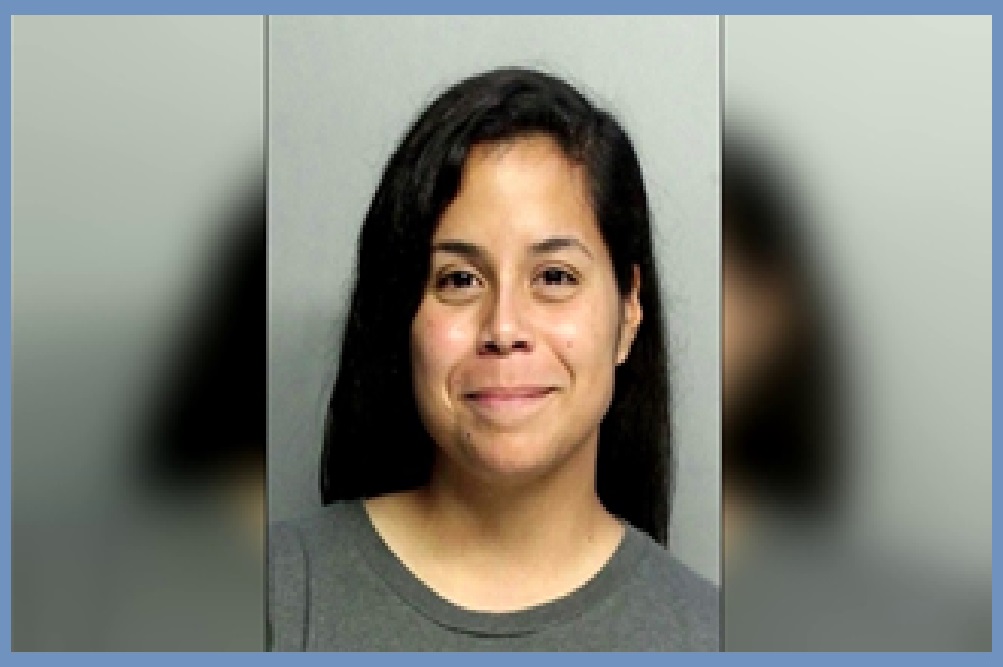
In Miami, Florida a 28-year-old woman snuck onto a high-school campus by posing as a student. She was walking around campus, talking to students, and handing out fliers with her Instagram handle on them in attempts to gain more followers. She was wearing a backpack, had a skateboard in her hands, and was carrying a painting to blend in. She even lied to security officers when stopped and questioned about why she was on campus, saying she was just looking for the administration office. You just have to love social media!
When security realized she was not a student, they attempted to confront her, but she rushed off campus as the potential threat was called in to administrators. She ignored the officers’ commands to stop, also known as ‘resisting arrest’.
She was arrested on charges of burglary, interfering at an educational institution, and resisting an officer without violence. This situation shows just how far someone will go to be popular on social media. No number of followers is worth facing criminal and civil penalties or potentially hurting yourself or others.
——-
Questions:
Be sure to provide full explanations for each of your answers. For more details, you can read the article this piece was sourced from here:
https://www.clickorlando.com/news/2021/05/12/florida-woman-posing-as-student-goes-to-high-school-campus-to-promote-her-instagram-police-say/#//
Contributed by: Marlee Carpenter
Thanks to overwhelming support,
Project REAL managed to secure the participation of
a number of leaders throughout Nevada.
They’ve committed to helping get the word out about #NVReturnReady.
Please consider doing your part too!
Watch and share the PSA below,
speak with young Nevadans in your life using the #ReturnReady guide,
and contact Project REAL to find out how else you can participate!
FOR IMMEDIATE RELEASE
Nevada Nonprofits Team Up to Prevent Teen Dating Violence
Project REAL and S.A.F.E. House providing free lessons to NV high school seniors.
Las Vegas, May 5, 2021 – Las Vegas based nonprofits Project REAL and Safe House have joined forces to help educate Nevada’s graduating seniors about domestic, family, and sexual violence. Together, the two agencies have published a free guide designed for seniors graduating high school in 2021. Now, they are working with other sexual and domestic violence agencies in the state to get the word out.
While any sexual or domestic violence is problematic, Nevada has a uniquely troublesome history with these issues. Prior to 2014, Nevada had the highest rates of reported domestic violence incidents in the U.S., and today it remains the community with the third highest rate in the nation. Sexual violence is also an issue for young people that needs to be immediately addressed, with 61% of victims that reported an incident of sexual violence being between the ages of 12 and 24, and 74% of the 12 to 24 age group knowing their perpetrator.
Police agencies across the country began experiencing what some refer to as a “pandemic within a pandemic,” with American law enforcement agencies reporting an 8.1% increase in calls about domestic violence across the nation after lockdowns began in March 2020. Clearly, there is reason to act on this issue now, which is why Project REAL and Safe House have launched their statewide initiative to educate graduating high school seniors in Nevada.
“Domestic and sexual violence are particular dangers for people aged 18-25,” said Safe House’s Community Outreach & Engagement Coordinator, Monica Roberts. “This is when patterns of violence begin that, if the person survives their abuse, will shape the rest of their lives. Experiencing domestic violence can lead to it seeming ‘normal’ to a victim, making them less likely to report their experiences or seek help for the danger they’re in. An 8.1% increase during the pandemic is really worrying because, based on what we know about domestic violence, it means we’ll be seeing significant spikes in the future.”
Project REAL and Safe House are leading the conversation with Nevada’s high school seniors. The agencies aren’t going at it alone, having reached out to other prominent agencies that address domestic, sexual, and family violence issues across the state for help creating awareness about this free resource. These other organizations have signed on to accompany the initiative in making sure Nevada’s youth are as educated and prepared for the reality of adult life as possible.
“This project is meant to help those already experiencing domestic violence or silently carrying the memory of an unreported sexual assault, but there’s also a signficant prevention aspect to this project – especially for young adults that experienced violence in their households during the lockdown,” said Mike Kamer, Senior Director of Project REAL. “The point of the guide is to make sure young adults are aware of these dangers and know how to handle or—ideally—avoid them.”
This team of specialized agencies and Project REAL are asking teachers of high school seniors to share this guide with their students and encourage them to download or review it. The free guide is available in both English and Spanish at http://projectrealnv.org/relationships.
For additional comments or more information from Project REAL, please contact Mike Kamer at mkamer@projectreal.org or (702) 703-6529.
For additional comments or more information from Safe House, please contact Monica Roberts at monicar@safehouse.org or (702) 451-4203.
Project REAL, a 501(c)3 non-profit organization, was founded in 2005 by Sam Lionel and Irwin Molasky to meet the challenge of teaching K-12th grade Nevada students the importance of the law. They have taught over 185,000 Nevada students about the importance of the law with the goal of preparing them to be informed, law-abiding and participating citizens through courthouse field trips, mock trials, and unique in-class experiences. For more information or to make a financial contribution so more students could benefit, please visit http://projectrealnv.org.
Safe House is a Las Vegas, Nevada community based non-profit organization committed to Stop Abuse in the Family Environment by providing a comprehensive approach to end domestic violence that includes crisis intervention, safe shelter, counseling, advocacy, and community education. The organization aids victims of domestic violence by providing shelter and other services. For more information or to make a financial contribution to help address domestic violence in Southern Nevada, please visit https://safehousenv.org/
###
What is a Nominal Court Case and Why Suing for a Single Dollar Might Be Beneficial

Pictured: A dollar bill to represent a nominal court case
Most court cases get resolved at federal level, meaning a majority of cases don’t make it to the Supreme Court. The ones that do are typically ones that question the U.S. Constitution or show violation of one of the Amendments. This would be a case from someone that claims an action, policy, or proposed law violated the First Amendment and Freedom of Speech. Policies written to regulate the First Amendment, especially in public spaces such as parks and universities, are often written in a vague sense that creates an umbrella over what is considered to be a violation.
For example, Georgia Gwinnett College student Chike Uzuegbunam sued the college for a dollar because he felt his First Amendment right to Freedom of Speech was being unfairly monitored. Most colleges have designated areas for students to express their opinions about political topics and to hold peaceful protests. There are regulated areas for this in order to maintain order on campus and to regulate possible distraction from study. In these areas any topic or protest is typically allowed as long as there is no violence and no violation of school, state, or nationwide laws.
Georgia Gwinnett College has a restriction on their public speech area so that students can only use it for four hours Monday-Thursday and two hours on Fridays with a 30 minute time slot each. Students also have to formally book this area and can only do so every 30 days. Uzuegbunam went through the necessary steps and requirements to book time to talk about his evangelical Christian faith which is a topic of discussion allowed in these areas. Several students complained and Uzuegbunam was told he was in violation and that he could only have one-on-one conversations and discuss literature. He was also told he was using “fighting words” by talking about his faith.
Fighting words is a doctrine in the First Amendment that restricts the public use of offensive language. Due to this claim and the supposed policy under violation, Uzuegbunam sued the college for a dollar claiming they were violating his First Amendment right. The college defended the claim by arguing that the discussion of faith was violating the “fighting words” doctrine.
The court supported Uzuegbunam’s claim because the college quickly abandoned their claim that “ the plaintiff used contentious religious language that, when directed to a crowd, has a tendency to incite hostility.” They changed the policy so that students can speak anywhere on campus, which they said made the case moot or insignificant. This action by the college caused them to lose the case because the amended policy was not in place at the time of Uzuegbunam’s speech.
In this case, and others of similar origin, are acceptable nominal damage cases because they are related directly to a violation of or concern about the U.S Constitution.
————————–
Questions:
1. Why might someone want to sue a person or organization for a dollar if they could sue for more?
2. What are some other known or possible nominal damage court cases? Explain the case.
3. What would a nominal damage case be like in a Nevada court? How would it differ from another state or the Supreme Court?
Be sure to provide full explanations for your answers. For more details, you can read the article this piece was sourced from here:
https://www.nytimes.com/2021/03/08/us/supreme-court-georgia-college-free-speech.html
Contributed by Saralynn Lindsay
 Thank you for letting us watch the civil case! It was cool because it was a real case and not one played out. I had a lot of fun watching the other kids act out a session. Thank you for your time.
- Kaylie [Hewetson Elementary - Grade 5]
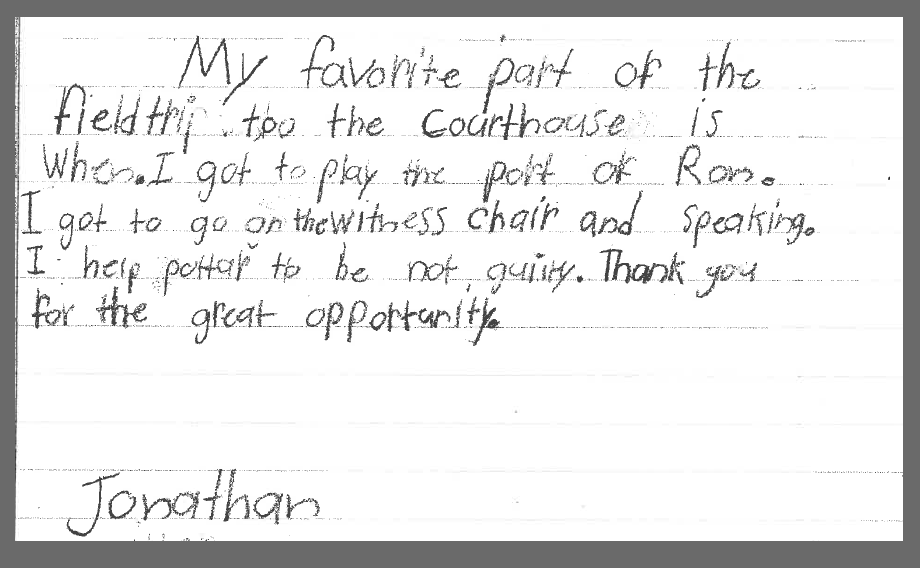 My favorite part of the fieldtrip to the courthouse is when I got to play the part of Ron. I got to go on the witness chair and speaking. I helped Potter to be not guilty. Thank you for the great opportunity.
 Thank you for letting us experience court for the first time. It was the best experience ever, thank you for everything. You really made me think about being a judge. Thank you
-Mina L [ Twitchell Elementary - Grade 5]