Twitter Posts, Politics, & You: Don’t Suggest Ways To Punch A Nazi, It Will Get You Banned From Twitter
A Man Makes a Tutorial on How to Punch a Nazi that Gets Him Banned on Twitter
Pictured: A screenshot of Thor Harris demonstrating a proper punch
Twitter is the one social media platform where almost anything is allowed. They lack the same strict guidelines that Facebook and Instagram have, allowing for an array of interesting tweets. The guidelines they do have, however, are typically about violence: don’t show or talk about hurting someone or your account could be briefly suspended. Now how violent does the tweet have to be for the account to get suspended?
Indie artist Thor Harris knows the answer to that. Back in January 2020, modern day neo-Nazi was punched in the face. The following February Harris tweeted a video he had made called “How to Punch a Nazi” which went viral. In the video he stated “don’t do it” and “peaceful protests are better”. Twitter suspended his account and removed the video for encouraging violence toward another person or group.
When back allowed on Twitter, Harris said the video was a joke, making fun of something that actually happened a month before. He wasn’t mad about his suspension because he was back on quickly and there was no other legal trouble so the event was more funny than anything.
————————–
Questions:
1. Did Harris break any laws by tweeting a video about “How to Punch A Nazi”? If so what possible laws did he or could he break?
2. How could breaking Twitter guidelines turn into a legal offense where police could get involved and the case be taken to court? Explain.
3. Should social media guidelines be taken seriously even if breaking them doesn’t result in breaking the law? Why or why not?
4. Are there any Nevada specific social media laws?
Be sure to provide full explanations for your answers. For more details, you can read the article this piece was sourced from here:
D’oh! Nuts!
Donut Champion Dunked Into A Jail Cell
Pictured: Artist’s interpretation of suspect being detained at the local jail…or not.
A North Carolina man was arrested for stealing and breaking into a Dunkin’ Donuts. According to police he is being charged with felonies including breaking and entering and larceny (meaning the theft of someone’s property). It wasn’t specified if any donuts were taken during the theft.
In 2014, the same man won a donut eating contest while being wanted on suspicion of multiple break-ins. After competing in the donut event, Bradley Hardison (the suspect) prompted closer watch by investigators which led to him being convicted. Ironically, he won the contest at the police department’s “National Night Out Against Crime” event.
Hardison was held on a $7,000 bond for his latest charges of breaking and entering and larceny.
————————– Questions:
1)What punishments could Hardison face for the breaking and entering charge in Nevada?
2) What punishments could he face for the larceny charge in Nevada?
Pizza is one of the most universally enjoyed dishes and a food most people won’t turn down. An alleged story about the temptation to eat the baked dough topped with delicious proteins, cheeses and veggies ended up costing four officers their jobs.
Jeff Clegg is one of the officers who was fired. Clegg claimed that employees of a pizza shop would park illegally and place menus visibly in their car window. When a parking enforcement officer saw the menu, they were not to write a ticket. If a parking ticket did happen to be issued, it was usually voided.
Clegg’s allegations also say that the officers didn’t write tickets to the employees for over two years because of the deal. Apparently the parking enforcers would frequent the pizza shop so often that they were on a first name basis with the workers. Some of the officers would even enter through the back and just grab their own meal!
The officers were in a situation where they could have issued 3 tickets a day to the pizza parlor’s problematic parkers, with each ticket having a fine of $25. At first, $25 per ticket may not seem like that large of an amount. Over the course of 2 years however, $75 in parking tickets each day would have amounted to over $19,000 in missed fines!
Following an investigation by a city official who’d heard about Clegg’s allegations about the parking-for-pizza scheme, Clegg and three other officers were fired. Shortly after that happened, the pizza restaurant’s owner complained directly to the city in person about how upset he was about the officers being fired. At the same time though, he denied that there was ever a free meal deal happening.
A second investigation was launched by a police agency, but no charges ended up being filed against the pizza parlor’s staff nor the 4 officers that had lost their jobs.
————————– Questions:
1) Keeping in mind that this deal could have cost the city up to $19,000 in missed fines, if charges had ended up being filed as a result of the investigations, what laws would the enforcement officers have been accused of breaking and what penalties might they face?
2) Keeping in mind that this deal could have cost the city up to $19,000 in missed fines, , what charges could be brought against the pizza restaurant owner, and what penalties might he be dealt?
3) Suppose the allegations were eventually proven to not be true though: Could the officers take action against the city for being fired over false accusations? If you think they could, explain how you think the officers would benefit from suing the city – what would they get out of it? If you don’t think they could, explain what makes you think they’re prevented from filing a case against their employers.
Law Firm Claims Rival Sucked Up Business
By Copying And Hijacking Their Website
We are taught not to copy a person’s work since it can get us in trouble. According to an article by Above The Law, a law firm is suiting another firm on the basis of copying and hijacking their website.
In Illinois, Motta & Motta is suing Dolci & Weiland over the alleged hijacking and plagiarism. The suit claims that Dolci capitalized on Motta’s reputation by using website hashtags and headers to mislead search engines into believing Motta’s website is Dolci’s website. According to the suit allegations, Dolci & Weiland’s website mirrored Motta’s copyrighted design and content and even copied (verbatim) articles and blogs on Motta’s website.
In school, we are taught many basic principles such as reading, writing, mathematics, but we also introduced into many ethical values as well, such as responsibility, quality, leadership, respect, and honesty. One way these ethical values are exercised is through integrity and not committing plagiarism. This article brings up some interesting points relating to privacy, defamation, and fraud and how Dolci’s law firm was acting unlawfully. Instead of Dolci taking the time to create their website and content, they are now facing a lengthy legal process that is going to cost them a lot of money!
————————– Questions:
1) In what situations is it against the law to impersonate someone online?
2) When would impersonating a person online be a form of fraud, or why would it not be a fraud?
3) The law firm that claimed to be victimized specifically mentioned hashtags in their complaint. Hashtags are basically hyperlinks: text that results in being connected to related information. If the law firm sued only over the plagiarism of the hashtags on their website, why do you think they would or would not have a good chance of winning their case in court? Be specific by using other lawsuits or trademark and copyright news articles as examples when creating your response.*
*Hint #1: Are companies guaranteed websites with their names?
*Hint #2: What are some examples of trademarks, copyrights, and the differences between the two?
Be sure to provide full explanations for each of your answers. For more details, you can read the article this piece was sourced from here:
Golden Answers & Golden Knights:
Questions About Laws and Fighting!
When two players get into fight in hockey, when two boxers hit each other during a boxing match, and when two UFC fighters engage in combat during a bout, they have all agreed to participate in the fight. When they are done fighting, no one is arrested.
If two people at a social gathering start to argue and agree to ‘step outside’ to fight each other, the police may be called and each of the combatants may end up facing charges including assault, battery, malicious mischief, breach of peace, challenges to fight, or provoking assault. ————————– Question:
1) What laws or policies allow for two people that fight during sporting events to not face criminal charges (even though the fights are witnessed by thousands of people), yet two people who consent to fight each other and engage in violence outside of a sporting event will probably face many different criminal charges for their fight?
2) What policies exist specifically in Nevada related to the last question about fighting in sports?
Be sure to provide full explanations for each of your answers. For more details, you can read the article this piece was sourced from here:
Seriously Stupid:
Swatting a School Shooting Survivor
A quick note for the olds: Swatting is when emergency services (like 911) are called by someone who hides their identity and falsely claims an incident that requires an immediate and armed response from law enforcement is taking place at an address. Swatting is a way to harass – and possibly harm – an intended victim by fraudulently provoking a police raid at their location.
During Spring 2018 in Parkland, Florida, local police responded to a call that claimed Parkland shooting survivor and anti-gun activist David Hogg was being held hostage. The caller claimed Hogg and his family were being held hostage by someone armed with an AR-15. Police showed up to his house “prepared for a shootout with an armed menace”. Shortly after arriving at the scene, the responding officers discovered that not only had the caller been lying, but that Hogg was actually out of town at the time.
On social media Hogg downplayed the incident, describing it a poorly-thought-out prank. Hogg had a reason for playing it cool though – after surviving the slaughter at his school on Valentine’s Day in 2018, he’s been a target for harassment from gun rights activist and conspiracy theorists. By downplaying the swatting incident and acting like it’s no big deal, Hogg was communicating to swatters that they are wasting their time trying to provoke fear or anguish in him.
Despite how Hogg reacted to the incident publically, swatting is an extremely dangerous act that needs to be taken seriously. It wastes police resources that might be needed somewhere where a real emergency is taking place, and the so-called prank can even result in death.
In December 2017, a 28 year old was killed by police that were responding to an emergency call. In a call to 911, a swatter claimed that a man had killed his father and was holding the rest of his family hostage in their home. When a young man opened the door at the house that was being ‘swatted’, police shot him thinking he was the gunman that had been reported. He died shortly after that. Given that the December 2017 swatting death was national news at the time, the person who attempted to swat David Hogg just a few month later knew there was a chance Hogg (or a member of his family) could have been inadvertently shot or injured by police.
————————– Questions:
1) Though the specific definition changes by jurisdiction, generally speaking ‘attempted murder’ is when someone has intent to carry out a murder or takes a substantial step towards committing a murder. Considering the circumstances of the attempted swatting of David Hogg, do you believe the swatter – if he or she were ever identified – could be convicted of attempted murder? Why or why not? What other charges might a person face if they were identified as being a person behind a swatting call to police?
Terror & Tyranny at the Theme Park:
Family Assaulted at Six Flags
Amusement parks go above and beyond to entertain their guests during Halloween each year. In Fright Fest at Six Flags, everyone is up for a good scare. The extra scares are appreciated, but the fall season also seems to bring an increase in bad behavior by some park attendees. What nobody wants is to come home injured or assaulted, but unfortunately, that fear became a reality for one innocent family.
The family – an elderly couple and their 12 year old son – was attempting to ride one of the thrill rides at the park. While waiting in line, a group of friends cut in front of the family. Skipping over the fact that the group had cut in front of them, the woman asked the group to at least stop using unpleasant language around her child.
That is when an attack began.
The 12 year old boy was physically seized upon by the group that had cut in front of his family. The mother and father attempted to intervene, but were quickly overwhelmed by the sizable group. The family continued to be assaulted with punches, kicks, and stomps by their attackers until they submitted to the violence and fell to the ground.
Security at Six Flags broke up the attack quickly after a passersby reported the incident. The attackers spread out in an attempt to escape, but fortunately most of them were prevented from getting away after security cornered them in the parking lot.
Local police reported to the scene, and a total of nine suspects were arrested & charged. Later on, the city’s police chief commented that more suspects may have gotten away. With this concern in mind, the police urged anyone with evidence to submit it to them. As the police chief explained “We know there’s a video out there. People had their phones out, but we have not gotten any additional video yet.”
Following the incident the family was rushed off and received care for their injuries, though eventually all three of them were discharged.
———————— Questions, Part 1:
Amusement parks have a lot of discretion in deciding what they allow to occur on their property. They have a duty to protect those who come, which is why they deal with high safety standards and inspections for their rides. The parks also allow a wide range of people to come in and enjoy themselves though.
1.1) Is the process to enter an amusement park too easy?
1.2) Should Six Flags be held financially or criminally responsible for the family’s injuries? What makes them responsible or not responsible?
1.3) If you think Six Flags is responsible, what can they do to prevent attacks like these in the future? If you don’t believe they’re responsible, what laws absolve them of that responsibility?
Questions, Part 2: Research your response!
2) The family of the incident experienced emotional and physical damage from the attack. What consequences will the assailants that were caught face?
Questions, Part 3: According to the park, attacks like these are uncommon, “This is rare.” was the official line from park representatives, yet still the park was prepared for possible incidents like these, having doubled security patrols during holiday seasons. Meanwhile, even with the double patrols, not all of the assailants were detained. Consider the fact that some of the suspects were able to get away and that police are hoping cell phone footage will help identify the remaining suspects. That means the park didn’t have sufficient security camera coverage to identify all of the assailants. With that in mind….
3.1) Should the family place blame on Six Flags for negligence based on the failure of it’s video security?
3.2) Should seasonal events like this continue when the parks know they pose a risk of an increase in violent or otherwise troubling incidents?
3.3) Some of the attackers in the incident were minors. Assuming their parents weren’t with them in the park, should the park be held responsible for allowing large groups of minors to be there without proper supervision?
3.4) What rules should be made for youth at parks, and should there be laws establishing standards for these rules (explain your answer – why or why not)?
3.5) Should security keep a closer eye on young adults at parks? What would lead them to be to strike out like this in such a large force?
Be sure to provide full explanations for your answers. For more details, you can read the articles this piece was sourced from here:
https://chicago.suntimes.com/news/frightening-fest-family-attacked-beaten-by-teenagers-at-six-flags/
– Submitted by J. Floyd
Did Russia Consider Returning Snowden to the US?
We May Never Know…
In February 2017, reports were circulating that Russia was considering sending Edward Snowden back to the US “as a gift for President Donald Trump” as reported by NBC. At the time, NBC cited an unnamed senior US official who has reviewed intelligence on the matter.
Edward Snowden has lived in Russia since 2013 and recently launched a campaign with his legal team to get him pardoned. Snowden still faces being charged with leaking classified information and treason for his pivotal role in the months-long releases of information about America’s digital surveillance programs, should he return to the United States.
In April 2017 however, Russian Foreign Ministry spokeswoman Maria Zakharova said publicly that Edward Snowden can stay in Russia until he decides to leave for himself. When asked, Zakharova did not clarify on if Russia would consider extraditing Snowden to the U.S. at a later point in time.
This post is about more than just an update to a news story about privacy law and policy. The difference in tone, content, and conclusion (or lack thereof) between the stories should lead readers to question the reliability of news stories that speculate. In an age where people of all political leanings and affiliations make claims of fake news, we encourage the students we connect with to consume all media – no matter the source – with critical eyes.
————————– Questions:
1) Why do you believe Edward Snowden’s Leaks were a good or bad thing?
2) Why do you believe Edward Snowden’s should or should not be punished for leaking the information that he did?
3) Why do you believe Edward Snowden’s should or should not be pardoned?
Be sure to provide full explanations for each of your answers. For more details, you can read the articles this piece was sourced from here:
Man Drags Unconscious Passenger Off
Blue Line Train in Long Beach, CA:
Witness Said He Wanted to Avoid Delay
On August 3rd of 2018, a video surfaced from California as a man in a suit drags an unconscious man off the train to avoid delay.
Controversial as this incident may be, the video depicts a white male in a suit dragging an unconscious black man. During the incident, the white male was recorded by a passenger on the train. The passenger explained how the unconscious man was wearing a medical bracelet, had metal staples in his skull, and threw up before going unconscious. In the video, onlookers expressed their anger towards the man in the suit by saying he had no right to assume he was partying, per an eyewitness. As an act of retaliation towards the man in the suit, the passengers held the train doors open, to prevent the train from leaving while they phoned the paramedics.
Once paramedics and officers arrived on the scene, the unconscious man was taken to the hospital, but the man in the suit was not investigated or a point of interest in this case. The video of this incident was posted on Youtube and gained momentum by its audience and local news stations. This is still an ongoing investigation.
————————– Questions: 1. Just because someone broke a law, that doesn’t mean they’ll always be prosecuted for it, so was it lawful for the man in the suit to drag the unconscious man to train platform, and would it lawful for him to leave the man behind?
2. In this case, the man in the suit will not be charged with this act, explain why you agree or disagree with this decision.
3. ‘Duty to rescue’ laws require people to help others if they witness someone in trouble and are able to help without endangering themselves. Are there ‘duty to rescue’ or similar laws where you live, and do you agree with your community having or not having them?
Be sure to provide full explanations for each of your answers. For more details, you can read the article this piece was sourced from here:
Salt Bae Gets Salty After
Health Code Violation Accusations
The man known as Salt Bae’s technique for salting steaks captivated the world, quickly elevating him to meme-status. After he opened his new restaurant recently however, some people weren’t so quick to ‘like and share’. A few sticklers for the law were quick to point out that he might be violating New York City’s health code.
Salt Bae’s critics pointed out that by salting steaks without gloves, this living meme appeared to be breaking clause 81.07 of the NYC health code. That clause states that there must be use of tools of ‘sufficient length to prevent bare hand contact with ready to eat potentially hazardous food’.
After being called out he started wearing gloves. With his salting technique which employs significant amounts of flair, pomp, and circumstance though, salt may still hit his bare forearm before reaching his customers’ plates.
A common condiment isn’t the only legal matter keeping Salt Bae so salty these days though.
According to videos he’s posted to Instagram, he had been slicing steaks at customers’ tables without gloves and while wearing a flashy watch – 2 more possible violations of NYC health code! In addition to the first violation, by wearing a watch he’s also violating a rule stating ‘food workers may not wear jewelry on their arms unless it’s a medical bracelet or smooth ring’..
New York City’s Department of Health said they would be launching an investigation into the violations. The restaurant opened earlier this year and has received mixed reviews over price, food quality and the overall experience. Sounds like this Salt Bae could use a little sweetness these days!
————————– Questions:
1) What consequences could the restaurant face if it is found to be violating NYC health code?
2) Can videos posted to social media be used as admissible evidence if charges are filed?
3) Do you think the case is being handled differently, or should be handled differently since a celebrity is involved?
Thank you for letting us experience court for the first time. It was the best experience ever, thank you for everything. You really made me think about being a judge. Thank you
-Mina L [ Twitchell Elementary - Grade 5]
Project Real
2020-12-16T22:04:09+00:00
Thank you for letting us experience court for the first time. It was the best experience ever, thank you for everything. You really made me think about being a judge. Thank you -Mina L [ Twitchell Elementary - Grade 5]
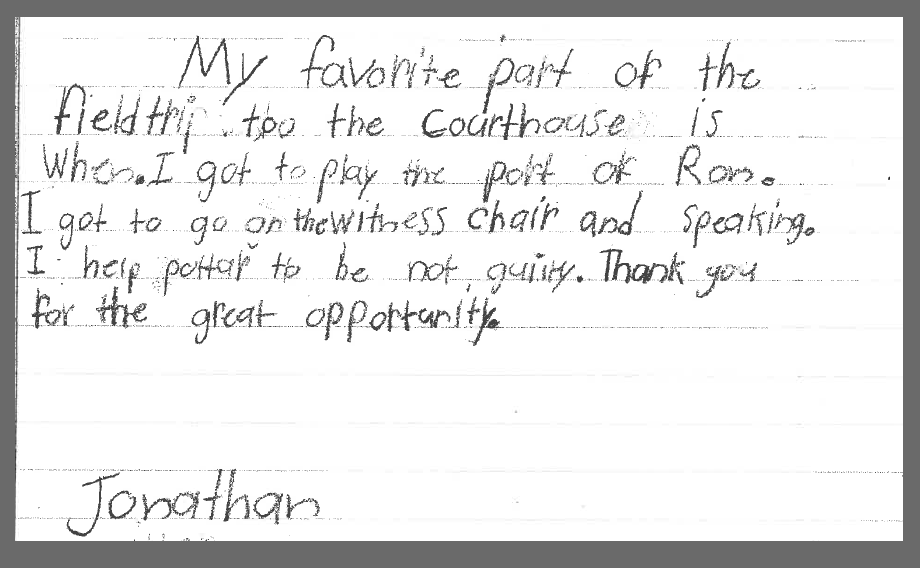
My favorite part of the fieldtrip to the courthouse is when I got to play the part of Ron. I got to go on the witness chair and speaking. I helped Potter to be not guilty. Thank you for the great opportunity.
- Johnathan M [Harmon Elementary - Grade 4]
Project Real
2020-12-16T21:47:04+00:00
My favorite part of the fieldtrip to the courthouse is when I got to play the part of Ron. I got to go on the witness chair and speaking. I helped Potter to be not guilty. Thank you for the great opportunity. - Johnathan M [Harmon Elementary - Grade 4]
Thank you for letting us watch the civil case! It was cool because it was a real case and not one played out. I had a lot of fun watching the other kids act out a session. Thank you for your time.
- Kaylie [Hewetson Elementary - Grade 5]
Project Real
2020-12-11T20:39:35+00:00
Thank you for letting us watch the civil case! It was cool because it was a real case and not one played out. I had a lot of fun watching the other kids act out a session. Thank you for your time. - Kaylie [Hewetson Elementary - Grade 5]