Criminal Complaints From
Villainous Avengers Fans!
Directors Anthony and Joe Russo received death threats for not putting the character Hawkeye in “Avengers: Infinity War.” His absence was first noticed when the first movie trailer was released in November 2017. As time got closer to the movie release date, it became clearer that Hawkeye wasn’t going to be featured in the movie. As a result, some of Hawkeye’s fans revealed that even villains love superheroes.
Actor Jeremy Renner, who plays Hawkeye, revealed that the director brothers were receiving death threats because his character was not included in the movie. When asked how he felt about the dedication being shown by some of his less respectable fans, Renner said “It’s a nice feeling I suppose. I think the Russo brothers got way too many death threats. I’m like, ‘Wow, dude, that’s intense. I’m sorry.”
Looking at Nevada Revised Statute 202.448, these threats appear to be criminal. The statue defines “making threats or conveying false information regarding acts of terrorism, weapons of mass destruction, lethal agents or toxins” as a criminal act.
NRS is a Nevada statute, but certain acts of issuing a threat are also federal crimes! United States Code Title 18 Chapter 41 Section 875 states that “whoever transmits in interstate or foreign commerce any communication containing any threat to kidnap any person or any threat to injure the person of another, shall be fined under this title or imprisoned not more than five years, or both.”
————————– Questions:
1) What are the maximum amount of penalties could be faced by the people who made the death threats to The Russo Brothers?
2) Explain the different legal penalties for threats made in person in comparison to threats made over the internet?
3) List 3 other laws regarding threats (other than NRS 202.448 and USC.18.41.875, and report what the maximum penalty for each one is.
A 2,000-year-old terracotta warrior from China had one of its thumbs stolen while in an American museum. The suspected thief was caught on camera sneaking into the warrior’s exhibit, taking a selfie with the statue, and then breaking off its thumb. The camera then caught him pocketing the terracotta thumb and taking it.
Not important but also interesting: the thief burgled the museum during an ugly0-sweater party being held there!
On the way home from the party, a suspect named Michael Rohana bragged to his friends about successfully stealing part of a warrior. A month later the FBI went to his house and questioned him which lead to the return of the missing thumb. As a result he was charged with multiple crimes including “concealment of an object of cultural heritage stolen from a museum” (meaning that he knew the thumb was stolen from the museum yet he kept it like it was his own belonging.)
The warrior statues were discovered by a Chinese farmer in 1974 but originally date all the way back to 209 BC. Sculptures like the one that had its thumb stolen were created in order to protect the tomb of China’s first emperor. At the time of the theft, the statue was worth $4.5 million. Additionally China has to send two experts to the United States to try and repair the thumb.
Chinese officials and citizens are upset at both the museum and the United States for the lack of security for the sculptures and for failing to protect the warrior from harm. Users of China’s Facebook-like service Weibo left critical comments about the incident, including one user who noted that the warriors “are kept far away from the public” (in China) and asked “How come the sculptures in Philadelphia are not displayed inside glass cases?”
The man – Michael Rohana – made a quick decision to mess with the terracotta warrior’s display to try and impress his friends. Now he has to face consequences starting with going to court, though he’s likely to face much worse than that!
————————– Questions:
1) Given the fact that the damaged item was originally worth $4.5 million and that the thumb portion of it was taken illegally, what are the lowest criminal charges or consequences the suspect can face (if they were charged in Nevada)?
2) The artifact was being borrowed while it was damaged. If China decides to take action against the US, what court would the case be taken to (China’s? American Federal Court? An American State Court?) and what charges could the US government face, if any? If not the government, who would end up in court and why would it be a criminal or civil case (pick one or the other and explain why you chose that way)?
3) Everyone know of someone (maybe even themselves) who’ve just done what the thumb-thief did: failed to think about the consequences and just quickly acted on an impulse. What is something you saw – or even did – that could have resulted in a lot of big trouble all because you or that person you saw just didn’t stop to think, and then act? What could the consequences have been?
Fashion designers often have a unique distinction on their products- a look or style that they are known for- and Christian Louboutin (pronounced LOU-EEE-BOO-TAWWWWN) is no exception. For over 25 years Louboutin has made the bottoms of his fancy dress shoes an unmistakable vivid red. Now there is question of whether or not he can trademark the color. His company had even trademarked “the color red (Pantone 18 1663TP) applied to the sole of a shoe” (like the shoes in the picture above).
In 2012, his company filed a lawsuit against Dutch company Van Haren that had started selling high heels with red soles similar to his. Louboutin filed the lawsuit claiming that the shoes “infringed on his brand’s trademark for footwear”, (meaning the red soles on fancy dress shoes).
The other company (Van Hare) was forced to stop selling their red-soled shoes after Louboutin sued them for trademark infringement. However the brand’s lawyers weren’t having it, and fought the case until it reached the European Court of Justice (meaning the case was heard by several lower courts first).
Under European Union law, shapes typically cannot be trademarked (so the design of a shoe might not be able to be legally protected, but a specific logo of a company still could be). According to a court official, Louboutin’s red soles are part of a shape (and not something like a logo). Because of the rules about shapes, his request for trademark protection could be refused.
Fashion designers fighting over colors in court might seem very European, but America has seen its share of legal battles over colors too! For example, in 2014 the United States Federal Court decided that AT&T was no longer allowed to use certain shades of pink after a lawsuit with T-Mobile.
AT&T had come out with a new service called Aio wireless that used a shade of plum in all of its advertising. While it wasn’t the exact same color as T-Mobile’s better-known magenta, it was close enough for a lawsuit to be filed by T-Mobile (and won).
————————– Questions:
1) No matter how the court case turned out, why should Louboutin be able or unable to trademark soles of shoes with a specific shade of red?
2) What if Nike made a sweet pair of red-soled running kicks: Should Louboutin be able to sue Nike if they did that – why or why not?
3) After considering & answering #2’s question about Nike shoes, answer this: What if Nike released a pair of red-soled running kicks and called them “Louie’s Batons” – as a way of saying Louboutin is wrong: almost like a protest to the lawsuit in Europe. If they did that, why should they be allowed or not be allowed to sell the shoe in those circumstances?
Controversial White House Tape & Records…
In 2018!?
One of the things the 1969-1974 Nixon Presidential Administration will always be remembered for are the controversial tape recordings made in the Whitehouse. Now thought of as a matter of history, at the time the taped recordings made at the White House were highly controversial. These taped records of conversation in the White House are credited as having played a major role in the resignation of President Richard Nixon.
Given all of that history, a situation where tape, record, president, and white house can be used in the same sentence is one that most administrations would try to avoid. The 45th president of the United States however has a reputation for doing things differently, which may be why we have this interesting story to share with you:
The Presidential Records Act of 1978 states that all presidential records must be preserved. You may not be familiar with the law, since you’re not President of The United States. So, you know – that’s fair.
When someone is elected to the Presidency of the United States for their first term, there’s a transition period during which they are taught about policies, procedures, and laws they need to abide by.
Despite measures like the briefings given to a president-elect, President Donald Trump apparently has a habit of ripping up things like notes, memos and other papers when he has finished with them. White house staffers have reportedly been taping these documents back together after the President has torn, ripped, or shredded them so that the administration remains in compliance with The Presidential Records Act of 1978.
Invitations, letters and newspaper clips with notes are regularly torn up by President Trump. Clear scotch tape was given to employees to piece the ripped documents back together. One employee who was fired early on in 2018 that had claimed he put papers back together on the job said “We’re making more than $60,000 a year, we need to be doing far more important things than this. It felt like the lowest form of work you can take on without having to empty the trash cans.”
The employee who was fired claims that when he left the office, employees were still regularly engaged in the practice of taping documents back together. Some White House staff called the ripping habit Trump’s ‘unofficial filing system.’ The White House had no comment on the situation when asked.
————————– Questions:
1) In America, no person – including – the president is not above the law. Everyone needs to #PlayByTheRules. That being said, if the documents are able to be pieced back together, does President Trump’s tearing up documents count as ‘document destruction’? Could it be successfully argued that tearing up documents is just a really bad system of organization that makes records preservation harder?
2) What if the president were to go further though? Imagine instead of liking to tear up documents when being done with them, a president preferred to set them on fire. Clearly then, the document would be destroyed. What would the legal consequences be for violating The Presidential Records Act of 1978?
3) Pick a side: Do you think that there are any laws a president should be exempt from?
– If you agree: What laws should a president be exempt from, and what are the reasons for exempting the president?
– If you disagree: Why should the president have to follow the same laws as everyone else? Are there benefits, and if so what are they? Is is simply to avoid risks, and if so what risks are being avoided by making presidents follow every single law that everyone else has to follow? Give a thoughtful, detailed, response!
Be sure to provide full explanations for each of your answers. For more details, you can read the article this piece was sourced from here:
https://www.politico.com/story/2018/06/10/trump-papers-filing-system-635164
Contributed by- J. Plummer
Welcome to Volcano Land:
Your New Home (Maybe?)!
Hawaii is known for a number of landscapes like beautiful beaches and volcanoes (including three active ones!) With one currently erupting there is a great chance that lava could reach the ocean. When it reaches the sea, the lava cools down and hardens creating more land called lava extensions.
This geological event leads us to a pretty interesting legal question: Since it was created by a natural event, who exactly owns this new land? Before we look for an answer, let’s get some background on where this debate began:
In 1955 a volcano called Kilauea erupted and created over 7.9 acres of new land. A local family purchased previously-existing land next to where the lava extension had formed. The new owners assumed that they had full rights to the recently created parts, and not just the initial land they purchased. They even paid property taxes and planted trees on it!
Following an eruption in the same area in 1960, the issue of who the land really belonged to ended up being taken to court. Hawaii’s State Supreme Court ended up ordering the land owners to leave the lava-extension, and then issued the land-rights for the lava extension to the state.
The court ruled that the land created by the volcanic activity was for the “use and enjoyment of all the people”; instead of only allowing one family or person to use the land as they please, everyone gets to use it!.
Since the court ruling established that land created by lava belongs to the state, that meant that all of the land created by Kilauea’s eruption in 1955 belongs to the state of Hawaii. As a result, it was not just the one family and their bit of land that was affected by the court case’s outcome.
————————– Questions:
1) Do you feel like the court ruled the right way? In other words, should a person who lives near lava-created land have the first chance to purchase it from the state before the government can decide to do something else with the new property? Would your opinion change if person wanting to purchase the lava-extended land lived in a house 20 feet away? Would it matter how long they’d been there – say….6 months….or 20 years?
2) In consideration of the questions brought up in number 1 above, tell us why you think the court ruling is or is not good enough, and why there should or should not be specific-laws be created to manage lava extensions in Hawaii ? Just for context (there is no right or wrong answer, so this isn’t a hint): There is A LOT of volcanic activity near Hawaii. It doesn’t always create land, but it could. How that fact influences your answer is up to you!
3) What about the government though? Hawaii’s State Supreme Court ruled the land was created for the “use and enjoyment of all the people”. Based on the wording of the court ruling, should the government be allowed to sell the new land to a business or individual, or should it be forced to use the land for a park, community center, or something along those lines? Tell us what you think and why you feel that way.
‘Your Government’ Sent You a Follow Request.
Do You Accept?
China’s government has begun to implement a system that ranks its population with a score based on their ‘social credit’.
The Chinese social credit score is similar to a financial credit score – it moves up or down depending on the behavior of the person being scored. The program is already being piloted for millions of Chinese citizens, and China’s government hopes the system will be in place for all of its citizens by 2020. The program was first announced in 2014. According to a government document, the system is meant to support the national ideal that “keeping trust is glorious and breaking trust is disgraceful.”
Any number of actions can impact a person’s social credit score in China’s program like trying to ride a train without a ticket, smoking in a non-smoking area, lingering in public spaces without explanation. Those are all reasons someone’s social score might be lowered, and they may seem reasonable – but there are other reasons that seem more troubling.
Whether someone buys unnecessary items, the amount of time they spend playing video games, what they post on social media, and if they spread what the government deems to be fake news are also sources of social score point reductions.
If you’re not already familiar with the Chinese Government’s definition of ‘fake news’, Google ‘China Government Tiananmen Square State News’, find a reliable source to learn from, and read an article or two about it. Then, think about their social scoring system again. (Spoiler Alert: If the Chinese government doesn’t like a story, they just delete it and can arrest the person who wrote it)
Refusing military service can also have a negative effect on your score.
If someone happens to get a bad social credit score, they could face barriers such as restricted travel. Meaning if your score is low enough you could be prevented from buying domestic flight tickets and business-class train tickets. You could also be barred from enrolling in higher education, unable to continue your studies and may not be able to enroll your kids in private schools.
Think about that: If you’re a straight A student that plays a lot of video games, you could be barred from enrolling in higher education because of how much you enjoy gaming – despite your good grades!
Having a good social credit score can also provide rewards like speeding up travel applications, receiving discounts on energy bills and even getting more matches on dating websites! Some citizens in China claim that the system has already made people’s behaviors improve.
————————– Questions:
1) If a system like China’s ‘social credit score’ program were to be implemented in America by the US Government, how would the program violate or not violate American citizen’s constitutional rights?
2) Constitutional rights aside, why would you want to live or not live in a country with a social scoring system?
3) If you were forced to live in a country with a social scoring system, what protections would you put in place to make sure everyone was treated fairly by the system? For example: If someone proposed points should be awarded to people that participating in sports, would that be fair to a quadriplegic? Should quadriplegics get bonus points? Is that fair for people that just don’t like sports? This sounds challenging, but in the context of the questions above, pretend that somehow the system could be made to be fair: what are the first 3 steps you would take?
FAA Investigates Harrison Ford After He Flies Over Jetliner Awaiting Takeoff
You might be able to complete the Kessel run in less than 12 parsecs, but that doesn’t mean you’ll outrun the Federal Aviation Administration’s ability to enforce laws and regulation!
In February of 2017, NPR reported that the FAA would be investigating Harrison Ford for flying his plane over a jetliner that had been waiting to takeoff – a violation of FAA safety procedures. The incident occurred as a result of Ford landing on the wrong runway. While he may have played a rebel-with-a-cause pilot that got away with everything in Star Wars while acting in the roll of Han Solo, in real life Mr. Ford is as subject to the law and FAA procedures as much as any other pilot.
————————– Questions:
1) What’s a story you recall where a celebrity had a run-in with the law?
2) Did you think the person received special treatment or harsher treatment because they were celebrities?
3) Sometimes, people may be ‘made an example by a court – after they are found legally responsible for a crime and when their punishment is being decided, a judge may decide to ‘send a message to the community’ that a type of crime will not only be illegal, but punished harshly. Then, the give the person the biggest punishment possible (there may still be limits to what the punishment can be based on the laws around the crime being punished). Sometimes this can happen to famous people. What do you think: Why is it far or unfair to let a person’s fame influence the size (scope and intesnsity) of their punishment?
For Hollywood stars, death might not be the end of their career. In the last couple of years movies have remastered deceased actors and actresses but, can they do that? What are the laws behind using someone’s image and voice after they’ve been long gone?
Perhaps you’ve seen Star Wars: Rouge One. Or maybe you watched the original film The Crow. In both these films, the likeness of actors who were deceased (in one case for several years and the other for just several weeks) were used after their deaths. Even concerts are using holographic technology and past recordings to put on shows using deceased musicians (with Tupac and Michael Jackson being famous and somewhat recent examples of this technique).
As digital manipulation technologies improve, so does the entertainment industry’s ability to use a performer’s likeness after his or her death. In some instances, the performer designated ownership of the rights to family members or their estates. In other cases, no clear guidance has been provided as to how their likeness may be used after a performer has passed away.
————————– Questions:
1) What do you think about companies using people’s likeness after they have deceased?
2) Why should their or shouldn’t there be laws requiring ‘designated consent’ before these methods are employed (meaning there needs to be laws that require a person to agree to their image being used if they die, and that no more projects like the ones in the story could happen until such laws were created to restrict that practice)?
3) What if movie studios start requiring performers to authorize use of their likeness after death – should there be limits to what requirements can be included in a performer’s contract?
After Teenage Mistakes, Pardons Give Second Chance to Ex-Offenders
Making a mistake is part of life and as a teenager you’re bound to make several but, making a mistake that defines your whole life when your 17 is the harsh reality for some. Contrary to popular belief, juvenile criminal records aren’t always sealed and can follow people throughout their lives.
What kinds of consequences might young offenders face? Foremost, a young offender with a criminal record may not be able to work in certain industries (jobs that involve working with children or positions that handle money will certainly be restricted). Even then, employers faced with choosing to hire between a candidate with a criminal record and one without one are more likely to hire the applicant without a criminal history. Difficulty securing work can lead to other life long problems. Without steady work, a person’s opportunity to make money is severely limited. This might lead to a life of poverty and the struggles that come with it.
Depending on the circumstances, a juvenile record that remains unsealed may be resolved through a pardon. The process for securing pardons for criminal histories of a minor differs from state to state, however that process is rarely short let alone easy. If a pardon is issued an individual may have an opportunity to secure a second chance at a productive and successful life for themselves, however pardons are rare and shouldn’t be considered a guaranteed solution.
New York is changing the lives of young offenders by granting pardons in some cases. The lesson isn’t to expect a pardon or a second chance, but rather to understand the struggle for the many individuals facing lives of constant struggle as a result of poor decisions they made as teenagers. Consider the consequences of your actions.
QUESTIONS:
1. What did you think happened to your ‘juvenile record’ before reading this news piece? In other words, before reading this piece, what did you think would happen once you turned 18 if you had been in legal trouble before becoming an adult?
2. Answer depending on how you feel: Why is it fair or unfair for the process of getting a juvenile record ‘sealed’ or hidden to be so difficult for some people? If you’re still not clear on the idea of a juvenile record, think about it like a ‘permanent record’ that follows you through life as you apply for schools, jobs, a place to live and really just about anything you want that would need some kind of application.
3. What is the process to get a juvenile record sealed in the state you live in? Specifically: How long can it take and what is the least amount of money it would cost to do it?
Viewed over 11 million times, one Indiana law enforcement officer’s fun video about a commonly ignored law has gone Viral. Indiana’s State Police Sgt. John Perrine was getting frustrated after witnessing numerous drivers failing to signal before turning or changing lanes, and decided to do something about it.
Rather than just spending time issuing ticket after ticket in hopes of word getting out, Sgt. Perrine created a surprising video discussing the ‘amazing technological advances and fantastic benefits’ of using turn signal technologies (the lights used by drivers to let people know if they are going to change lanes, so the people behind them don’t speed up and create an accident). The amusing video is a friendly reminder to use your turn signal, but also that officers are people who like to have fun at work when they can just like the rest of us!
There’s more to the story than an officer being creative while on the job: Sgt. Perrine is a Public Information Officer in his region, meaning one of his duties is to serve as a communication point in the community. Police departments throughout the country – including Nevada – have officers like Sgt. Perrine in place to help build relationships between officers and the communities they serve.
——— Questions:
1: Research and report : What is something fun or interesting that police officers that have done in your community?
2: Why do you think it is important or unimportant for officers to engage with the community (do things other than ‘official policing stuff’) ?
3: What is something that you don’t think police officers already do in your community that you would like them to, and why would you want them to do that?
Thank you for letting us watch the civil case! It was cool because it was a real case and not one played out. I had a lot of fun watching the other kids act out a session. Thank you for your time.
- Kaylie [Hewetson Elementary - Grade 5]
Project Real
2020-12-11T20:39:35+00:00
Thank you for letting us watch the civil case! It was cool because it was a real case and not one played out. I had a lot of fun watching the other kids act out a session. Thank you for your time. - Kaylie [Hewetson Elementary - Grade 5]
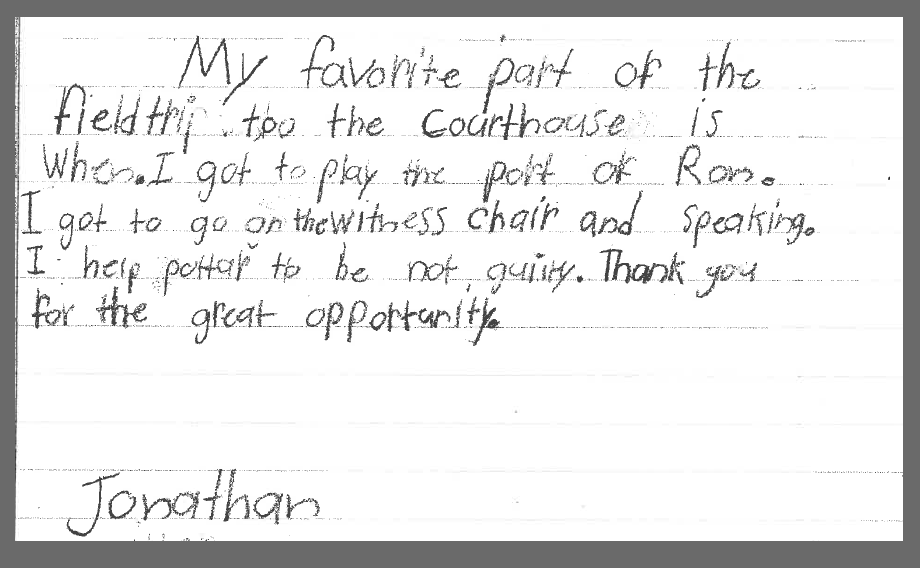
My favorite part of the fieldtrip to the courthouse is when I got to play the part of Ron. I got to go on the witness chair and speaking. I helped Potter to be not guilty. Thank you for the great opportunity.
- Johnathan M [Harmon Elementary - Grade 4]
Project Real
2020-12-16T21:47:04+00:00
My favorite part of the fieldtrip to the courthouse is when I got to play the part of Ron. I got to go on the witness chair and speaking. I helped Potter to be not guilty. Thank you for the great opportunity. - Johnathan M [Harmon Elementary - Grade 4]
Thank you for letting us experience court for the first time. It was the best experience ever, thank you for everything. You really made me think about being a judge. Thank you
-Mina L [ Twitchell Elementary - Grade 5]
Project Real
2020-12-16T22:04:09+00:00
Thank you for letting us experience court for the first time. It was the best experience ever, thank you for everything. You really made me think about being a judge. Thank you -Mina L [ Twitchell Elementary - Grade 5]