Tourism, Trespassing, & You: Don’t Do Disney on the Down-low!!!
A Florida Man Arresting for Trespassing on Disney Property
Pictured: 42-year-old Richard McGuire, the man who was caught trespassing on Disney property
The last year has been both crazy and relatively boring. The entire world was in lockdown for various amounts of time causing millions of Americans to stay at home. Everyone began to become restless, wanting nothing more than to get out of the house four a couple of days.
One man in particular, 42 year old Richard McGuire, decided to do just that by going on a week-long camping trip. This seems harmless right? He would be socially distanced, not breaking any Covid-19 related laws. What this man claims to have not realized was that he was breaking other laws. You see, in America camping is perfectly acceptable, but only in designated areas. This man went looking for a place to camp and found his way to what he claimed to be a “tropical island”. The island he was referring to was Walt Disney World’s Discovery Island.
Just like most all other non-essential businesses in America, the Happiest Place on Earth had to shut down during the pandemic, still remaining closed. Anyone that steps foot on Disney property while the park is closed is trespassing. Since Disney is such a large and popular company they are well prepared for catching anyone that is there outside of business hours. This man walked onto the island on Monday, ready for a week of camping, and was found by security on Thursday.
Security knew when made his way onto the island, but because of the nature and dense plant life they had trouble tracking him down. They had search parties on foot, boat and helicopter, all of which the man claimed he never heard. Once he was found he said he didn’t know it was Disney property but simply a “tropical paradise”. The issue was that in order to get to the island he had to pass two gates and several no trespassing signs. He was also warned by Orange County Marine deputies that he was not allowed on the island.
Once found, the man was arrested and charged with a misdemeanor of trespassing. He also lost all Disney privileges and is not allowed on any Disney property.
————————–
Questions:
1. Do you think it was possible for the man to not know he was on a Disney island? Why or why not?
2. What else could the man be charged for? Explain your answer.
3. Is revoking all Disney privileges necessary? Why or why not?
4. What would be the consequences for trespassing if Disney World was in Nevada?
Be sure to provide full explanations for your answers. For more details, you can read the article this piece was sourced from here:
Pictured: Aldo Gonzalez, the man who filmed the hazmat suit prank
We live in a world where kids spend more time on the internet than they do outdoors. With YouTube and Tik Tok there is an endless supply of prank ideas for kids to use on their parents or even strangers. Sometimes these pranks seem harmless yet there are victims. When the only one left laughing will be the prankster, the wannabe comedian may want to rethink their plans. This is especially true if the law can become involved.
Take this incident for example from March of 2020. At the time, Aldo Gonzalez was a 23 year old resident of Las Vegas, Nevada who had a “hilarious” idea. He and an unidentified juvenile friend of his would dress up in painter suits and go around a local Walmart spraying people with water for a YouTube video. The two young men hoped the video would go viral.
Seems funny right? There were two problems with the prank though – it was taking place when the world was just beginning to come to grips with the fact that the COVID-19 pandemic was happening, and no one at the store knew it was water (except – of course – for the pranksters).
Since the victims of the prank did not know what was being sprayed, the Walmart was evacuated and the police were called. The shoppers (understandably) thought they were being sprayed with a much more harmful substance than water.
The police showed up to Gonzalez’s house and arrested him for spraying a hoax substance in a public place….and burglary! He was the one behind the camera and his friend was the one running around spraying people. While juvenile records aren’t public, we can reasonably assume the young man that did the spraying faced serious legal consequences as well.
We see pranks like this on social media all the time thinking it’s harmless and funny. Somethings we might even want to try for ourselves. Next time you see a prank online think about the consequences and if others would find it funny.
————————–
Questions:
1. What charges might the juvenile suspect face for the crime, and what long-term consequences might they face as adults for this incident?
2. Why was Gonzalez charged with burglary?
3. What other state charges could Gonzalez face besides burglary and ‘spraying a hoax substance’?
4. What federal charges – if any – could Gonzalez and the juvenile have faced, or why would they have not faced state charges?
5. What are some other “pranks” that might result in a young person being criminally charged, and what might those charges be?
Be sure to provide full explanations for your answers. For more details, you can read the article this piece was sourced from here:
Las Vegas, March 26, 2020 – “Parents, please keep an eye on your older kids, keep them close, and know what they are doing. Keep them busy at home,” advised Clark County Sheriff Joe Lombardo at a press conference Wednesday.
Nevada-based nonprofit Project REAL stands ready to support Sheriff Lombardo’s request by helping families during this challenging time by providing them with access to free, activity-filled lessons that improve children’s behavior.
Play by the Rules teaches over 200 Nevada laws and the consequences of breaking them. Project REAL’s carefully designed activities help families encourage good behavior by their children, which is especially important when students, facing idle time, risk finding new and inventive ways of getting into trouble even if they don’t mean to do so.
For those families without internet access, Project REAL has copies of the books available in English and in Spanish. The organization is currently seeking community partners assisting at student meal pick-up sites to help get the print copies of Play by the Rules to families in Southern Nevada. Community partners that are already distributing books include Project 150, Project Listos!, and Arriba Las Vegas Workers Center.
For families with internet access, digital versions can be obtained on demand. “In response to the rapidly developing Covid-19 situation, last week we immediately began working to make our student books and teachers’ guides easily accessible online to the families of Nevada. Everything is free and easy to download from our website,” said Project REAL’s Executive Director Tom Kovach.
Community partners interested in distributing the physical copies of the free Play by the Rules books should contact Project REAL’s Program Director Mike Kamer to set up a no-contact pickup appointment for the books. Kamer can be reached at mkamer@projectrealnv.org or by calling (702) 703-6529.
Project REAL, a 501(c)3 non-profit organization, was founded in 2005 by Sam Lionel and Irwin Molasky to meet the challenge of teaching young students the importance of the law. Project REAL has taught over 185,000 Nevada students about laws with the goal of preparing them to be informed, law-abiding and participatory citizens through their courthouse field trips, mock trials, and unique in-class lessons & activities. For more information or to make a financial contribution so more students could benefit, please visit http://projectrealnv.org.
A Woman Shoots Her Boyfriend Over a Cold Taco
Pictured: A taco sold by a food truck in Texas
Have you ever been to a restaurant and ordered food expecting it to come out hot? Then when the food arrives it’s cold and disappointing? The common reaction to receiving cold food is to send it back to the kitchen. Well what if they refuse to reheat it or make you a new plate? It might be frustrating, you could get mad, but how would you react?
A woman in Houston, Texas was in this exact situation when she visited a taco truck with her boyfriend. She received a cold taco that they refused to heat up. She quickly became furious. So much so that she pulled out a gun. Her boyfriend tried his best to calm her down but failed. She shot him. It’s unclear if it happened on purpose because she was so mad or on accident during the struggle of calming her down.
The boyfriend didn’t suffer any fatal wounds and the taco truck employee remained untouched. It is also unclear if the boyfriend pressed charges against his girlfriend or if she was banned from the taco truck.
————————–
Questions:
1. What types of charges could this woman face if this incident happened Nevada?
2. How would this case be different legally (if at all) if the taco truck employee was the one that got shot?
3. How would the consequences and charges change if the shooting was on purpose, rather than an accident?
Be sure to provide full explanations for your answers. For more details, you can read the article this piece was sourced from here:
ICYMI: President Lincoln’s Act
to Encourage Immigration
President Lincoln passed The Act to Encourage Immigration, July 4, 1864—the first, last, and only major law in American history to encourage immigration. Approved on July 4, 1864, the act was ultimately repealed. The repeal of The Act to Encourage Immigration could not, however, remove the effect it had upon immigration.
According to Time.com, “The Act, in 8 sections, authorized the President, by and with the consent of the Senate, to appoint a Commissioner of Immigration for a term of 4 years at $2,500/year; and a subordinate Superintendent in New York at $2,000/year. Section 2 provided that emigrants pledge their wages for no more than 12 months to cover their transportation here, but barred “any contract contravening the Constitution of the United States, or creating in any way the relation of slavery or servitude.” (Basically, it said immigrants could have other people pay to bring them here, but those people couldn’t treat them like slaves and only take the money the new immigrants earned for one year – after that the immigrants were free to do whatever they wanted).
Section 3 exempted all immigrants arriving after the passage of the act from compulsory military service unless the immigrant voluntarily renounced under oath his allegiances to the country of his birth, and declared his intention of becoming a citizen of the United States. That promise (called a waiver) was a big deal at the time, since the military was drafting many American men into service to fight in the civil war!
————————–
Questions:
1) Since there are many active debates about immigration these days yet this historical fact revolves around an act thaw was ultimately repealed, do you think this bit of history should be taught in classrooms? On one hand, it is a way to tie the past to the present which could help to bring history lessons home for students like you. On the other hand, the fact that the act was repealed takes away from its relevancy.
2) Do an online search for ‘American Immigration During the Civil War’, and then report back: What people and cultures may have been encouraged to emigrate to the United States as a result of Lincoln’s order?
3) Using your response to #2, answer this: How did the effect of Lincoln’s order shape the world we live in today? In other words, what about our daily American lives might be traced back to this specific order of President Lincolns?
Be sure to provide full explanations for each of your answers. For more details, you can read the article this piece was sourced from here:
The World War II Era
Italian-American Immigrant ‘Threat’
An Executive Order is a type of ‘lawful order’ that a president can create without that ‘law-ish thing’ having to be a bill or get approved by congress first. It’s not exactly a law, but people have to follow it anyway.
Perhaps you’ve heard of a very famous Executive Order: E.O. 9066. That order – issued during World War II – led to America’s internment of its Japanese-American citizens during. What is less well known about that order is the fact that it also forced over 10,000 Italian-Americans to relocate, and that it prevented an additional 600,000 Italian-Americans from being able to freely travel in the country!
The modern-day debates on immigration in America tend to focus on supporters asking for equal treatment of all people, while detractors (people against immigration) being concerned about immigration in general, but also expressing more focused concerns about people from Central America, South America, and the Middle East.
As the WWII order illustrates, immigration policies have affected all types of Americans throughout the country’ s history. At the time of EO 9066, information from the US Census Bureau was used to target Italian-Americans within hours of the executive order being signed! Events like that have even led to people being afraid of the census today (though they shouldn’t be – there are many new legal preventions in today’s world that would prevent that kind of abuse of census information).
————————– Questions:
1) What feelings do you have about how modern day America handles immigration?
2) A rare ‘There is a wrong answer to this question’ warning: Responding with ‘It doesn’t/hasn’t’ is 100% wrong. So – How does America’s identity as ‘A Nation of Immigrants’ directly shaped / impacted your life? Give at least three examples.
3) Read the original article that inspired this one (at the link below) and then explain: Why were Italian’s singled out during WWII along with the Japanese? What made them ‘a threat’?
BONUS :: A second rare ‘There is a wrong answer to this question’ warning: Responding with ‘It doesn’t / hasn’t’ is 100% wrong. So – Explain how at least one American immigration law or policy directly shapes or impacts your life today.
Here is an example (that you cannot copy or use): The author of this article’s life is impacted by passport rules. They want to travel to India, but first they need to renew their American Passport, which is pretty expensive!
Be sure to provide full explanations for each of your answers. For more details, you can read the article this piece was sourced from here:
3 Assassinations, International Intrigue,
& Your Right to Remain Silent…
“You have the right to remain silent. Anything you say can be used against you. You have the right to an attorney….” Those words – which you may recognize from shows or movies – are the words used to inform someone who is being arrested if their Miranda Rights. They’re not just for entertainment though – they are very real rights every American is entitled to, but they have only been read to suspects since 1966. That process came about as a result of a Supreme Court decision, but their origins date back much earlier. In fact, the process of reading a suspect their Miranda Rights is rooted in a historical event that took place in 1919.
That year, a triple murder of foreign diplomats occurred in Washington D.C. (a diplomat is someone who acts as the representative of a foreign government). The three victims all worked for the Chinese Educational Mission before being assassinated. When there were no leads or clear motives, the police focused in on the only suspect they had.
On the day of the assassinations, a young Chinese student named Ziang Sung Wan had been seen at the house where the killings had occurred. The police went to his home in New York and after searching it without a warrant, pressured Wan (who was suffering from a flu at the time) into going back to Washington D.C. with them. Upon their arrival, the authorities isolated Ziang in a hotel room and held him without formally placing him under formal arrest. After extended periods of isolation and interrogation that lasted more than 9 days, they eventually pressured him into making a confession.
During trial for the murders, Wan took back his confession, saying that he only confessed to make the detectives’ interrogation come to an end. The judge refused to acknowledge Wan’s statement despite the conditions that were used to obtain his confession. Eventually, Wan was found guilty of first degree-murder. At the time, the penalty for a guilty first-degree murder conviction was death-by-hanging.
Wan’s case was one of many at the time that had stirred debate among judges and lawyers in the country over which police conduct and interrogation methods were lawful, and which of those methods and behaviors were unlawful. At the same time, Ziang’s attorneys were filing appeals and pursuing their client’s acquittal relentlessly, knowing that his life was on the line. Eventually Ziang’s lawyers managed to get his case heard by the Supreme Court of The United States (SCOTUS).
As a result of the raging national debate in the law community over police tactics and the constitutional questions raised by Ziang’s case, one justice was tasked with drafting up a decision that would lay the groundwork for the Miranda Rights we know today.
Justice Louis D. Brandeis wrote the court’s decision, in which the court interpreted the Fifth Amendment as permitting only volunteer confessions as being admissible as evidence in federal court proceedings, and that a confession could be coerced involuntarily even if an explicit threat had not made.
If that’s too wordy, think about it like this: The police didn’t tell Ziang “If you don’t confess we’re going to break your legs”. Because they held him for 9 days though – while he was sick, in uncomfortable conditions, and without telling him when they would stop – they had basically forced him to confess to end the torment he was experiencing.
Unfortunately, because Wan had been tried in Washington D.C. (which is a federal jurisdiction) the new standard only applied to cases in federal courts. The ruling wouldn’t apply to states or local court proceedings for years. The standard created by Justice Brandeis’ ruling also ended up being interpreted in a variety of ways for decades after it was first issued. For years after the ruling, cases ended up before SCOTUS that would produce rulings which added more specificity to Justice Brandeis’ initial court opinion on Ziang’s case.
Eventually, in 1966 Chief Justice Earl Warren would mandate safeguards for suspects dealing with police in the opinion he issued for SCOTUS in the case of Miranda v. Arizona. Those safeguards would eventually develop into the Miranda Rights most people are familiar with today. His writings leaned heavily on the court opinion issued in response to Wan’s case, making it clear the Ziang Sung Wan v. United States is the legal soil from which the Miranda Rights we know today grew from.
Thanks to the Wan and Miranda decisions, today suspects are informed that they have the right to remain silent, that anything they say may be used against them in the court of law, that they have the right to counsel, and that if they are unable to afford one, an attorney will be appointed for them.
————————– Questions:
1) Now that you know some of the history behind Miranda Rights, do you have any feelings about your right to remain silent? What questions do you have about your right to remain silent?
2) TV may lead you to think that the right to remain silent is only used by criminals who are done talking to police and want to leave the interview. That’s not the case at all though. What are some situations that could lead someone to exercise their right to remain silent?
3) Suppose you found yourself needing to exercising your right to remain silent. What would that look like? Simply saying “I wouldn’t talk” isn’t enough: Tell us Why you might have decided to exercise your right, what you would do while exercising that right, how you would be treated while exercising the right, and the possible benefits and consequences of remaining silent.
Be sure to provide full explanations for each of your answers. For more details, you can read the article this piece was sourced from here:
A Man in North Carolina Brings a Bag of Snakes to the Library
Pictured: A bag of snakes to represent the one brought into the Madison County Library
Service animals are pets that are allowed in public places like schools, restaurants, and grocery stores. They are usually used for emotional support for anxiety or PTSD or used for medical assistance for the blind or someone that suffers from frequent seizures. Service animals are typically dogs, sometimes cats, but any animal can be registered as a service animal. The problem with that is some animals might not be accepted in public. Someone might freak out if they saw a person with say, a snake wrapped around their arm.
This is, kind of, what happened at a public library in Madison County, North Carolina. A man walked in with a bag. A girl sitting close by became concerned when it started moving. She felt uncomfortable and left, but before doing so she told the librarian, Peggy Goforth, that this guy had a snake in the bag. The man not only had one snake but a dozen snakes that he poured onto the table. He introduced them as his pets, being proud of them and not seeing the problem of bringing a dozen snakes into a public library because to him they were just like having a dog there.
The bag of snakes was just the beginning. Within that same year Goforth had to send away a monkey, a chicken, a parrot, an iguana, and more. This led to a new policy that only service dogs are allowed in the library. The policy follows guidelines outlined in the Americans with Disabilities Act. The policy also narrowed the acceptance of service dogs to exclude emotional support dogs.
————————–
Questions:
1. Why do you think this man decided to bring his pet snakes to the library in a bag?
2. Do you think bringing a pet to the library is beneficial? Why or why not?
3. Why do you think the policy excluded emotional support animals from the allowed service animals?
4. Would bringing a pet other than a service dog be allowed at your local library?
5. What is Nevada’s law on animals in public?
Be sure to provide full explanations for your answers. For more details, you can read the article this piece was sourced from here:
A Black Woman Was Arrested For Using Her Use of the Bike Lane
Pictured: A screenshot from the video of Genesis Hansen with the police officer that arrested her
In late 2019, when the 2020 Black Lives Matter movement was starting to form, more cases of incidents between people of color and police officers began to arise. Some of these cases were covered by the news and others weren’t. It is important for everyone to know their basic rights for their legal safety, even doing things that might not seem illegal or abnormal.
Riding a bike is an enjoyable pastime or mode of transportation for kids and adults alike. When riding a bike outside of your neighborhood it’s important to know where to ride your bike on a public street and the rights that you have while riding.
A 21-year-old Black woman, Genesis Hansen, was arrested in Oregon after being pulled over by a police officer for a possible misuse of the bike lane. The police officer and the woman disagreed on the action that caused her to be pulled over.
During the argument the police officer asked the woman for her ID so that he could look her up in his system and possibly give her a ticket. She refused to provide her ID to the officer because she wanted more information on the order he was giving her and why her identification was necessary while riding a bike.
In Oregon it is legal to deny identifying yourself if you don’t feel it is necessary. This woman was acting in her legal right. She politely asked for more physical information from the officer who continued to refuse to show her documents of the law. He then threatened to arrest her if she did not comply.
She asked for more information about her legal rights one more time and then was put under arrest and tackled to the ground by the police officer and another cop that was called to the scene. The officer was sitting on her back and she said she was not moving and he was acting forcefully.
Later, when the case went to court, the charges were dropped because the woman was acting in her legal right to not show her ID. The video that was filmed using the cops dashboard camera showed no evidence that she was resisting arrest.
————————–
Questions:
1. Do you think this woman should have been arrested? Why or why not?
2. Do you think there was anything beyond the misuse of the bike lane that influenced her being pulled over or arrested? Why or why not?
3. If you were in a similar situation, walking along the street or riding your bike in the designated areas and were stopped by a police officer and asked for your ID would comply and hand it over or would you question the request? Why or why not?
4. If in that situation how would you react?
Be sure to provide full explanations for your answers. For more details, you can read the article this piece was sourced from here:
A woman is led away during the protests Monday, Jan. 20, 2020, in downtown Las Vegas, after activists gathered on Fremont Street to protest two controversial city policies that ban camping downtown. The activists blocked Casino Center Blvd. through the Fremont Experience following a rally at Las Vegas City Hall
On November 6, 2019, the City of Law Vegas’ city government created an ordinance that essentially criminalized ‘willful homelessness’. The law made it punishable by up to six months in jail and up to a $1,000 fine for people to camp or sleep in Downtown Las Vegas, public areas near residential housing (like sidewalks near homes), or near businesses that deal with food like restaurants or convenience stores.
Camping in those areas was made illegal – but only when homeless shelters have beds available. If the homeless people in Las Vegas have beds being offered to them, they can accept them or face penalties that may include a fine of up to $1,000 and up to 6 months in jail. This is why supporters argue the ban is only on ‘willful homelessness’. If the shelters don’t have enough beds,
On January 15, 2020 Las Vegas’ city government passed a second ordinance that expands upon the November 2019 ban on willful homelessness. This expansion ordinance makes it illegal for homeless individuals to camp on any sidewalk when it is scheduled to be cleaned up using city resources.
In response to the expansion-ordinance, over 100 activists swelled the Freemont Street Experience (The FSE) area of Downtown on Monday, January 20, 2020 – Martin Luther King Jr. Day, and a national day of service. In acts of protest, at least 12 individuals out of the 100 attending the protests were arrested for blocking one of the streets along The FSE by setting up tents or laying down on the sidewalk – a clear and intentional violation of the original ordinance (since The FSE is in the heart of downtown).
Today both ordinances are still in place, however the protests drew national and international attention to Las Vegas including coverage by major news outlets like CNN, NPR, USA Today, FOX News, and AP News among others. That coverage also led to members of Las Vegas’ city government receiving criticism and condemnation from nearly all 2020 presidential candidates.
————————– Questions:
1) Why do you agree or disagree with the cause?
2) Why do you agree or disagree with the action?
3) Why do you agree or disagree with the punishment / consequences?
4) What cause – if any – would make you want to knowingly break the law, and why?
5) What are some better courses of action you can think of besides breaking the law in support of a cause you care about, or if you feel there aren’t any, what obstacles would prevent your from engaging in lawful resistance?
Be sure to provide full explanations for each of your answers. For more details, you can read the article this piece was sourced from here:
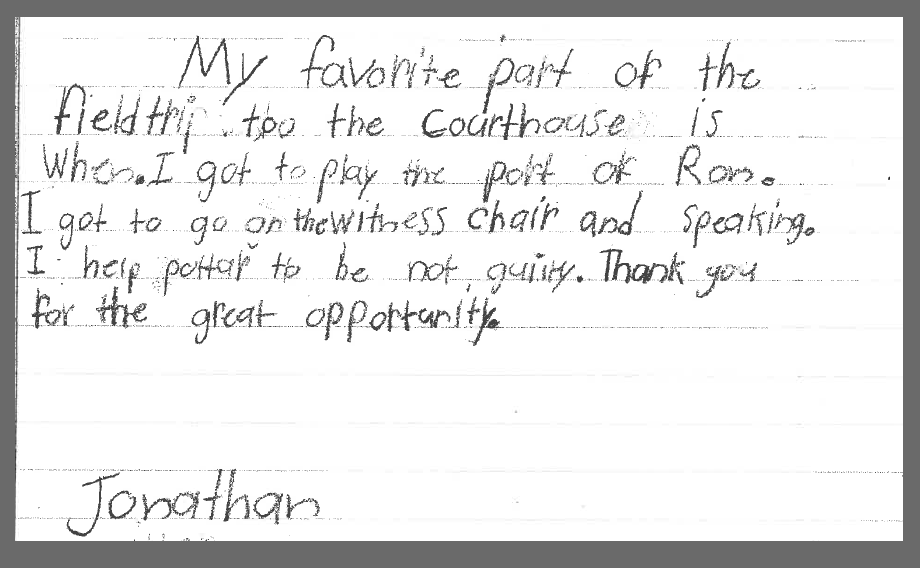
My favorite part of the fieldtrip to the courthouse is when I got to play the part of Ron. I got to go on the witness chair and speaking. I helped Potter to be not guilty. Thank you for the great opportunity.
- Johnathan M [Harmon Elementary - Grade 4]
Project Real
2020-12-16T21:47:04+00:00
My favorite part of the fieldtrip to the courthouse is when I got to play the part of Ron. I got to go on the witness chair and speaking. I helped Potter to be not guilty. Thank you for the great opportunity. - Johnathan M [Harmon Elementary - Grade 4]
Thank you for letting us experience court for the first time. It was the best experience ever, thank you for everything. You really made me think about being a judge. Thank you
-Mina L [ Twitchell Elementary - Grade 5]
Project Real
2020-12-16T22:04:09+00:00
Thank you for letting us experience court for the first time. It was the best experience ever, thank you for everything. You really made me think about being a judge. Thank you -Mina L [ Twitchell Elementary - Grade 5]
Thank you for letting us watch the civil case! It was cool because it was a real case and not one played out. I had a lot of fun watching the other kids act out a session. Thank you for your time.
- Kaylie [Hewetson Elementary - Grade 5]
Project Real
2020-12-11T20:39:35+00:00
Thank you for letting us watch the civil case! It was cool because it was a real case and not one played out. I had a lot of fun watching the other kids act out a session. Thank you for your time. - Kaylie [Hewetson Elementary - Grade 5]