Three College Boys Cut Down a Tree For an Unofficial Fraternity

Pictured: The tree stump of the rare Algonquin Pillar Swiss Mountain Pine tree
Thousands of college students around the country join fraternities and sororities. It is a tradition for pledges to participate in hazing and pledge activities which are usually wild acts that are supposed to show their loyalty to the fraternity or sorority. Sometimes these acts are illegal and there is the possibility of students facing legal consequences.
In November 2020 a rare 25-foot Algonquin Pillar Swiss Mountain Pine tree on the University of Wisconsin Arboretum campus was cut down. The area where the tree was located is 30 yards from campus and is a popular area for joggers, bicyclists, etc. The local police and campus security acted on a tip they were given about who might have stolen the tree.
On March 26 three 19 year old college students admitted to cutting down the tree as part of pledge activity to the former Chi Phi fraternity. This fraternity has not been recognized as an official school organization since 2015. This means it is not an official fraternity supported and funded by the University of Wisconsin. These 3 guys admitted to buying a chainsaw, renting a U-Haul, and stealing the tree. After hearing about how rare the tree was they destroyed it and disposed of it outside of the city line.
Each student was cited a $200 fine for cutting down the tree. More details about the legal action taken place were not disclosed due to privacy laws related to student discipline. However, the students can face both campus discipline as well as criminal sanctions.
————————–
Questions:
1. The fraternity that the 3 guys were pledging was not an official college organization. How might their campus discipline and legal consequences be different if it was a campus recognized fraternity? Would there be any difference at all?
2. How might the consequences be different if the tree was a more common species of pine tree? What if this did not happen on a college campus?
3. Are there any laws in Nevada that prevent someone from cutting down a tree?
4. What would the consequences be if this happened at a Nevada University like UNLV or UNR?
Be sure to provide full explanations for your answers. For more details, you can read the article this piece was sourced from here:
https://www.ketk.com/news/weird-news/3-students-cited-in-theft-of-rare-tree-in-wisconsin/
Contributed by Saralynn Lindsay
FOR IMMEDIATE RELEASE
Project REAL Launches Youth Law-Awareness Campaign as Students Return to Classrooms
The Nevadan legal-education nonprofit asks all adults to help young Nevadans avoid ‘accidental crime’
Las Vegas, Wednesday, April 7, 2020 – Earlier this month, Nevada nonprofit Project REAL launched a public education campaign to help every young Nevadan avoid trouble with the law as we begin the transition back to in-person schooling. #NVRETURNREADY asks every adult in Nevada to hold brief conversations with the young people in their lives to help them avoid making innocent mistakes that cross the line of the law, and momentum supporting the initiative is growing quickly.
The campaign provides a free discussion guide to help foster short yet crucial conversations that teach young people to make decisions only after considering if there might be legal consequences for their choices. These lessons are taught with examples provided by judges and law enforcement officials that illustrate common situations in which teens and adolescents get into trouble with the law without realizing their actions were criminal.
“Project REAL continues today to reflect the purpose and passions of its founders, Irwin Molasky and Sam Lionel. Created in 2004 to help local youth stem their negative involvements with the law, the Project fosters learning about the legal and judicial systems in an effort for participants to gain knowledge for positive self-assessment, building productive personal life experiences and becoming meaningful forces in the southern Nevada community,” said Las Vegas’ Mayor Carolyn G. Goodman in praising Project REAL.
Nevada students have begun returning to school after spending a year close to home and away from larger groups of friends, and there is real concern about the unintended consequences of these renewed social interactions. As students begin seeing more of their friends and spending time out in public, even the most responsible young people may be tempted to make up for roughly thirteen months of lost memories in ways that can place them in legal peril.
Project REAL’s Senior Director Mike Kamer points to the urgency for this initiative as “something that should be a concern for all adults. Even the most well-behaved kids and teens can make decisions that—unknown to them—cross the lines of the law. The courts won’t accept ignorance of a law as a defense for breaking it. Even the most strait-laced, straight-A student can make a mistake like exploring an abandoned property; that could be construed as innocent by the youth, but that activity constitutes trespassing in the eyes of the law. We need to help these students make smart and informed decisions, and we need to do it now.”
Many prominent organizations, government offices, and leaders from across Nevada have signed on to bring #NVRETURNREADY to residents across the state, and the list of supporters continues to grow. The developing list of partners in the initiative currently includes:
American Assoc. of Jewish Lawyers & Jurists – Las Vegas
Clark County Commission Chairman Marilyn Kirkpatrick, District A
Clark County Commissioner Justin Jones, District F
Clark County Juvenile Justice Services
Clark County, Office of the District Attorney
Communities in Schools – Southern Nevada
Downtown Vegas Alliance
Economic Opportunity Board of Clark County
Eighth Judicial District Court
Elko County Bar Association
The Harbor
Henderson Equality Center
Henderson Police Department
Jewish Nevada, Nevada’s Jewish Federation
Justice Lidia Stiglich, Supreme Court of the State of Nevada
Kamer, Zucker, & Abbott
Las Vegas Councilwoman Michele Fiore
Las Vegas Councilwoman Victoria Seaman
Las Vegas Justice Court
Legal Aid Center of Southern Nevada
LVMPD Foundation
LVMPD Community Oriented Police Services (C.O.P.S.) – Northern Area Command
Mayor Daniel J Corona, West Wendover
Mayor Carolyn Goodman, Las Vegas
Mayor John J Lee, North Las Vegas
Mayor Debra March, Henderson
Mayor Hillary Schieve, Reno
NAACP Branch #1111, Las Vegas
National Bar Association, Las Vegas Chapter
Nevada Attorneys for Criminal Justice
Nevada State Assemblyman Steve Yeager, 9th District
Partnership Carson City
Public Education Foundation
South Asian Bar Association of Las Vegas
Sheriff Allen & Humboldt County Sheriff’s Office
Sheriff Elgan & Esmeralda County Sheriff’s Office
Sheriff Furlong & Carson City Sheriff’s Office
Sheriff Hunewill & Lyon County Sheriff’s Office
Sheriff Wehrly & Nye County Sheriff’s Office
UNLV William S. Boyd School of Law
Washoe County Bar Association
Clark County Commission Chairman Marilyn Kirkpatrick remarked that the value of Project REAL’s initiative comes from its simplicity when she said “As a member of the Clark County Board of Commissioners, I’m enthusiastically in support of Project REAL’s #NVRETURNREADY initiative. All adults in Southern Nevada should take a moment to speak with the young people in their lives. A simple reminder to think before making any rash decisions, as we all make the safe and gradual return to being out and about in the community, can be impactful for all young Nevadans.”
The conversation takes place with just four steps outlined in the guide, and is designed with all adults in mind – not just parents and guardians. This was an essential part of the planning for Project REAL. The organization insists that there is a need to have the highest volume of impact in the least amount of time, given the rapidly changing landscape of young people returning to pre-pandemic activities like walking between school and home and being further away from their homes than they have been in a year.
“This is every adult’s problem. Teachers, parents, coaches, mentors—any adult with young people in their lives is at risk of getting a call from a police station because a young person they know made a mistake,” explained Project REAL’s Executive Director Tom Kovach. Noting the need for community support, Kovach emphasizes, “We can’t do this on our own, so we’re asking every employer, government office, and community organization in Nevada to tell the adults they know about the #NVRETURNREADY guide. If we work together statewide, we can ensure every student in Nevada is prepared to reenter community activity when COVID restrictions are relaxed with a decreased risk of getting into legal trouble.”
The guide is available for download in English and Spanish on the Project REAL website. Project REAL asks that any businesses, nonprofits, and government offices of any size that wish to become involved in the #NVRETURNREADY campaign contact Project REAL’s Senior Director Mike Kamer at mkamer@projectrealnv.org or (702) 703-6529.
About Project REAL
Project REAL, a 501(c)3 nonprofit organization, was founded in 2005 by Sam Lionel and Irwin Molasky to meet the challenge of teaching Nevada’s K-12th grade students the importance of the law. They have taught over 185,000 Nevada students with the goal of preparing them to be informed, law-abiding, and participating citizens through courthouse field trips, mock trials, and unique in-class experiences. For more information or to make a financial contribution so more students could benefit, please visit http://projectrealnv.org.
Media Contact
Andrew Wishon
andrew.wishon@curastrategies.com
(910) 231-1758
###
An Autism Behavioral Center Was Tagged With the R Word in Canada

Pictured: The wall of the Autism Behavioral Services Inc. that was tagged with the graffiti partially covered up
All over the world, in different types of cities and good and bad areas of town you can find a building, street sign, underground tunnel, etc. with graffiti on it. Sometimes the graffiti is actual art, a piece that someone put effort into creating using spray paint. The thing that makes it graffiti is it is usually done on a private building or city property without permission. Cities all over the world have buildings with murals that look like some graffiti that can be found. The other type of graffiti, and the more common type among young people is tagging. This is going to a building and writing a nickname or word on the wall. What most teenagers don’t realize is that graffiti, tagging or thought-out art, is illegal.
In Fergus, Ontario, Canada Freya Hunter runs Autism Behavioral Services Inc. which is a behavioral facility where she helps parents and children under the age of 18 learn about their specific type of autism and how to grow, learn, and handle their condition . Late at night between March 23 and 24, 2021 someone wrote the R-word on the side of the building. Hunter and the families of the children she helps were very upset and hurt by this.
The R-word lands in the same category as other slang words such as the N-word. It is sometimes said as a joke or in a non offensive way but to people who have autism it is very offensive. Hunter said she wasn’t sure if the graffiti was meant to be harmful but that it was the only building out of several that were tagged that night that had the word so it felt like a personal attack.
The Autism Behavioral Services building did not have security cameras installed at the time so there is no way of knowing who did it. Hunter hopes that one of the other buildings that got tagged had security so that the person can be found and identified. She said she wouldn’t press charges but that she would like to give them community service hours by having them spend the day with her kids so that they can be properly educated on autism.
————————–
Questions:
1. This specific graffiti example happened in Canada. What laws would be broken if it happened in America? Nevada?
2. If the offender is found and they are under the age of 18 what consequences might they face? Do those consequences change if they are a legal adult?
3. This person tagged many other cars and buildings besides Hunter’s. She stated she would not press charges but would work with them for community hours. What would happen if one or more of the other people whose property was damaged pressed charges?
Be sure to provide full explanations for your answers. For more details, you can read the article this piece was sourced from here:
https://globalnews.ca/news/7716623/autism-services-building-fergus-r-word/
Contributed by Saralynn Lindsay
La vida vuelve paulatinamente a la normalidad tras un año en el que han permanecido cerca de casa y alejados de muchos de sus amigos. Por desgracia, algunos jóvenes de Nevada pueden acabar reponiendo ese tiempo perdido en maneras que -sin saberlo- cruzan las líneas de la ley. ¡Los tribunales no aceptan la ignorancia de la ley como defensa para infringirla, de modo que esos jóvenes nevadenses pueden acabar enfrentándose a graves consecuencias por sus decisiones desinformadas!
#NVREGRESARLISTO está aquí para ayudarle a asegurarse de que los errores de los jóvenes en su vida no los lleve a tener que entrar en el sistema de justicia después de un año que en sí ha sido difícil. Al oprimir la portada del libro REGRESARLISTO2021 se iniciará la descarga de una guía que le ayudará a dirigir una breve conversación sobre como “pensar dentro de la ley” con los jóvenes que conoce.
También puede descargar otras dos publicaciones que le proporcionamos a continuación: Play By the Rules (Respetar las reglas del juego) para las edades de 10 a 15 años, e Independence & You (La independencia y tú) para las edades de 16 años en adelante. Estos materiales le ayudarán a seguir la conversación sobre cómo tomar decisiones más seguras después de tener la conversación #NVRETURNREADY.
Muchas gracias por su compromiso en preparar a los jóvenes de Nevada #NVREGRESARLISTO
Conozca nuestra campaña aqui:
http://projectrealnv.org/nvreturnready
Looking for more information about #NVRETURNREADY?
Life is gradually returning to normal for young Nevadans after a year of remaining close to home and away from many of their friends. Unfortunately, some of those young people may end up making up for that lost time in ways that – unbeknownst to them – cross the lines of the law.
Imagine: A teen and some friends decide it’s finally time to explore that abandoned property in the neighborhood…only to end up being charged with trespassing when they get caught for some decision any kid might make! The courts do not accept ignorance of the law as a defense for breaking it, so those young Nevadans can end up facing serious consequences for their uninformed choices!
#NVRETURNREADY is here to help. Clicking on the RETURNREADY2021 book cover will begin a download of a guide. That guide will help you hold a brief conversation about ‘thinking within the law’ with any young people you know.
Along with the guide, you can also download two other publications we’ve provided:
Play By the Rules for ages 10-15, and Independence & You for ages 16 and up.
These materials will help you keep the conversation about making safer choices after you have the #NVRETURNREADY conversation.
Thank you for your commitment to getting Nevada’s Youth #NVRETURNREADY
Learn more here
http://projectrealnv.org/nvreturnready
Local Nonprofit Will Take Nevada’s Students to Court With Virtual Field Trips
Project REAL is improving student behavior by connecting them with Nevada’s many judges
Las Vegas – February 23, 2020 – Law related education nonprofit Project REAL has teamed up with judges throughout the state of Nevada to offer virtual field trips to local students. These ‘Virtual Visits’ improve behavior in students while teaching them about laws, constitutional rights, and career opportunities in the American court systems.
The organization’s virtual field trips last 45 minutes, with judges first discussing their paths to the bench before opening up the session to questions from the students. Each classroom has its own unique experience thanks to the variety of judges participating – judges from both the state and federal court systems have signed up to participate. Having connected with many teachers already, Project REAL is happy to announce they have a number of these virtual field trips still available for educators and parents that would like to reserve them.
“We knew our local judges were committed to serving the community, but the response we received when we asked them to volunteer still managed to shock us! We are extremely grateful for their eagerness to mentor our students, and have more than 50 virtual field trip opportunities to offer the community thanks to their support. Now we want to make sure their generosity is fully benefiting the community by making sure every one of those virtual trips gets used by classrooms here in Nevada” said Project REAL’s Senior Director, Mike Kamer.
Project REAL reports that these brief sessions make a significant contribution to community safety throughout Nevada. Each year since the 2015-2016 school year when the organization first began collecting feedback, at least 84% of students reported wanting to improve their behavior after attending one of the field trips.
The first few virtual court visits of the current school year have already taken place, with Las Vegas Justice Court’s Judge Harmony Letizia having presided over two 5th grade classrooms from Twitchell Elementary. As the Justice of the Peace observed, “Each time I speak to students, they are fascinated by criminal law and procedure. It is one of my favorite ways to donate my time by helping to teach these students a basic understanding of the law. Project REAL’s field trips are providing a crucial context to these students and giving them a cursory distinction between rules and laws.”
Thanks to the judges that have already volunteered, Project REAL has a surplus of roughly 50 fieldtrips remaining. Teachers can request a reservation and parents can request more information at https://projectrealnv.org/
Questions or requests for additional comments on the Virtual Visit courthouse field trips from Project REAL should be directed to Project REAL’s Senior Director Mike Kamer at mkamer@projectrealnv.org or (702) 703-6529.
Additional comment requests for Judge Harmony Letizia should be directed to her Judicial Executive Assistant Adriana Martinez at Adriana.Martinez@
Project REAL, a 501(c)3 non-profit organization, was founded 15 years ago by Sam Lionel and Irwin Molasky to meet the challenge of teaching young students the importance of the law. Project REAL has taught over 185,000 Nevada students about laws with the goal of preparing them to be informed, law-abiding and participatory citizens through courthouse field trips, mock trials, and unique in-class lessons and activities. For more information or to make a financial contribution so more students could benefit, please visit http://projectrealnv.org.
###
Local nest station KSNV provided some excellent coverage of our announcement! Be sure to check that piece out here:
https://news3lv.com/news/local/project-real-students-legal-education-las-vegas
A Night of Underaged Drinking isn’t Worth Going to Jail

Pictured: 18 year old Blaklee Sands, who took the idea of ‘fake it till you make it’ too far…
Kids have the tendency to want to grow up quickly. They want to be able to make their own rules and do things that adults get to do like drinking alcohol. Sometimes when they get to be 18 and are considered a legal adult they try to get away with drinking publicly. The issue is you need proof of being 21 so a fake ID sounds like a good idea right? Wrong. Having a fake ID can cause more legal issues than fun if caught.
Take 18 year old Blakelee Sands for example: She went to a bar in Edmond, Oklahoma and her fake ID was taken because the person checking IDs was able to tell it was fake. Having gotten so mad that the bar didn’t just deny her but took the fake ID from her, Blakelee called the police on the bar!
When the police arrived, she claimed that she was at least 21 years old (the legal drinking age) and that the bar was holding her ID wrongfully. She then asked the police to get it back to her. The police officer that showed up ran her ID. While the information printed on the ID claimed her name was McKamie Queen, upon scanning it the officer received information saying the ID was a Texas identification card… belonging to a Robert Sanchez.
Sands was arrested for presenting a fake ID to an officer, and later admitted that she didn’t think she’d get caught. In the end, her failed attempt at a night of fun could have been just that…but because of a few additional decisions, it turned into a night in jail!
————————–
Questions:
1. If this happened in Nevada, what would the minimum and maximum punishments be for Blaklee?
2. Why do you think the bar didn’t call the police when they first realized it was a fake ID?
3. What federal charges could Blaklee have faced, and why?
4. How much of a difference – if any – was there in the consequences Blaklee faces since she was 18 years old instead of 17 when the incident occured?
Be sure to provide full explanations for your answers. For more details, you can read the article this piece was sourced from here:
https://wset.com/news/nation-
Contributed by: Saralynn Lindsay
Since students began attending school digitally in March of 2020, they have spent the majority of their time confined indoors. With a high likelihood that students will return to in-person learning before the end of the year, Project REAL hopes to help parents prepare their children in the transition back to normalcy.
As part of a Ready2Return 2021 initiative, Project REAL is asking all parents of young students to contact them for free law- related lessons that have been improving student behavior in Nevada for over 15 years. Students will eventually return to having unsupervised and unstructured time just like during life before the pandemic, and Project REAL wants to set Nevada families up for success in that change.
“Young Nevadans lost a year’s worth of freedom already — walking to and from school, weekends with friends — a year’s worth of freedom they’ll want to make up for. At Project REAL, we view that as a perfect storm of pent up energy that could lead to poor decision-making and risky behaviors. We’re extremely concerned that some students may even end up breaking the law without realizing it,” said Project REAL’s Senior Director Mike Kamer.
Parents of Nevada students in grades 3 through 12 will find grade and age specific lessons that teach laws and the consequences of breaking them. Many of the lessons are specific to Nevada law, making the experiences all the more relevant. Over 85% of students report wanting to improve their behavior and decision -making as a result of a Project REAL experience they’ve had.
“Whether it is in March 2021 or December 2021, Nevada’s youth will soon be returning to having more unsupervised and unstructured time out in the world. In those conditions, their choices can shape the rest of their lives. Project REAL works because we give students experiences that have been carefully designed to teach them the real-world consequences of poor decision making. These experiences are exactly what are needed to prepare Nevada’s students for a return to normalcy,” said Project REAL’s Executive Director Tom Kovach.
Parents that are interested in using Project REAL’s lessons with their families should visit Project REAL’s website http://projectrealnv.org. More information about Project REAL’s work can also be requested by sending an email to mkamer@projectrealnv.org.
Project REAL, a 501(c)3 non-profit organization, was founded in 2005 by Sam Lionel and Irwin Molasky to meet the challenge of teaching K-12th grade Nevada students the importance of the law. Project REAL has taught over 185,000 Nevada students about the importance of the law with the goal of preparing them to be informed, law-abiding and participating citizens through courthouse field trips, mock trials, and unique in-class experiences. For more information or to make a financial contribution so more students will benefit, please visit http://projectrealnv.org.
###
A Man Gets Arrested After Calling the Police For a Ride

Pictured: 22-year-old Matthew Leatham’s mugshot
There might be a time in your life when you’re in desperate need of a ride. Maybe your car broke down or you missed the bus. It’s important to know who to call for a ride so that you can get to where you need to go safely. Calling the police for an escort might sound like a good idea at the time, but it’s not and here’s why.
A 22 year old man in Florida, Matthew Leatham, found himself without a ride on February 3, 2021. Instead of calling a friend, family member, or looking for the closest bus stop he decided to call 911 and ask them to pick him up. When he called dispatch helped him call for a taxi. A few minutes later he called 911 again asking for a ride because he didn’t have money to pay for the taxi ride.
After the second call the police showed up to his location and instead of giving him a ride home they gave him a ride to jail. Leathman was initially arrested for misuse of the 911 system. During his arrest he was given a typical pat down and search during which the police officer found marijuana on his person.
Leatham was released on a $300 bond and it is unknown if he has to return to jail or if he is awaiting trial.
————————–
Questions:
1. What would have happened to Leathman after his arrest if the police did not find marijuana on his person? What would the consequences be if this happened in Nevada?
2. The amount of marijuana Leathman had is unknown. What would the consequences be if he had 20 grams or less on his person? If he had 20 grams or more?
3. This case happened in Florida where only medical marijuana is legal. How would the arrest be different if it happened in Nevada where the use of marijuana is legal for anyone 18 and older?
Be sure to provide full explanations for your answers. For more details, you can read the article this piece was sourced from here:
https://www.oxygen.com/crime-news/matthew-leatham-florida-man-with-face-tattoo-calls-911-for-ride
Contributed by Saralynn Lindsay
Who is Responsible if a Robot Commits a Crime?

Pictured: Dancing robots programmed by Boston Dynamics
In late 2020, Robotics lab Boston Dynamics released a video that was both super adorable…and absolutely terrifying. In the video robots, programmed to have artificial intelligence, are dancing.
These features seem fun, but let’s think-this-out for the future. These dancing robots with artificial intelligence are originally programmed to dance but they can learn other skills beyond what was originally taught to them. Some robots have been made to do more than walk and talk like drive cars and make their own decisions. They call this artificial intelligence. A robot is programmed with basic actions, thoughts, and knowledge, then, just like any human, can learn and develop thoughts on their own.
The tricky part with robots is knowing who is responsible when a crime is committed. If it does something wrong, even something minor, like walking across the street where there isn’t a crosswalk, who is responsible for its actions? Or if it decides to rob a bank?
Some say that the designer is responsible because they are responsible for the basic thought process of the robot, based on how the designer thinks. Others think the robot is solely responsible because they are designed to think on their own and build knowledge off of experiences.
Robots have come a long way from being walking toys. It can be difficult to know how to treat a robot in a criminal case if it has never happened before. The more advanced the technology gets the more difficult it is to know who is responsible for the robots actions.
————————–
Questions:
1. Who should be held accountable for a robot’s actions, the robot or the designer? Why?
2. If a driverless Tesla causes a car crash who is responsible? The designer of the driverless technology or the robot driving the car?
3. Do you think a computer programmed robot has the ability to become as fully functioning as humans? Why or why not?
4. If a crime is caused by an artificial intelligent robot in Nevada what might be the consequences? Does the severity of the crime matter?
Be sure to provide full explanations for your answers. For more details, you can read the article this piece was sourced from here:
To see the video….
https://www.youtube.com/watch?v=fn3KWM1kuAw
And to see the article that inspire….
http://www.vocativ.com/417732/robots-punished-committing-crimes/
Contributed by Saralynn Lindsay
 Thank you for letting us experience court for the first time. It was the best experience ever, thank you for everything. You really made me think about being a judge. Thank you
-Mina L [ Twitchell Elementary - Grade 5]
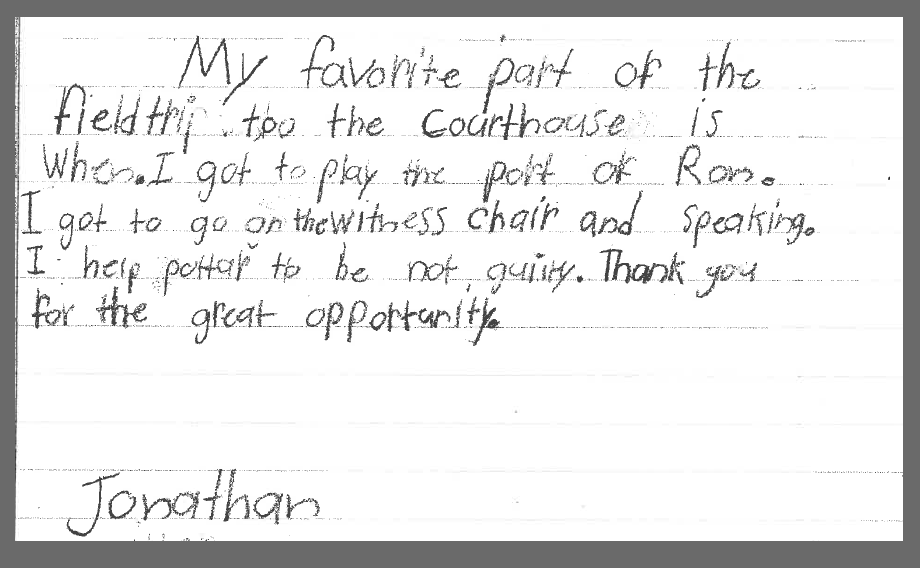 My favorite part of the fieldtrip to the courthouse is when I got to play the part of Ron. I got to go on the witness chair and speaking. I helped Potter to be not guilty. Thank you for the great opportunity.
 Thank you for letting us watch the civil case! It was cool because it was a real case and not one played out. I had a lot of fun watching the other kids act out a session. Thank you for your time.
- Kaylie [Hewetson Elementary - Grade 5]