Project REAL Works to Turn Vegas Orange,
Prevent Relationship Violence Through Teen Education About Laws.
On Thursday, February 9, 2023 Project REAL team members were joined by Commissioner Michael Naft, CCSD Superintendent’s Chief of Staff Shana Rafalski, John Torre of the Clark County District Attorney’s Domestic Violence Unit, & Sara Slavenas of the Nevada Coalition to End Domestic and Sexual Violence at the Welcome to Las Vegas Sign.
Since February is Teen Dating Violence Prevention month and orange is the color used to hilight the issue of teen relationship violence, the others joined us as we flipped the Welcome to Vegas sign orange for 24 hours…to bring attention to Project REAL’s free Teen Dating Violence prevention experience & resources.
If you’re looking for those resources, please follow this link to the mini-site we’ve created specifically for this work:

Teen Dating Violence Awareness Month:
Nevada experts on how to help
KNPR featured our Senior Director along with team members from SAFE House and Teens Against Trafficking to discuss Teen Dating Violence Awareness (or Prevention) Month. Visit the link above to hear the story, learn about our work, and to hear the original segment on KNPR’s State of Nevada.
Please support the reporters and news outlets that help tell our story.
Explore the original coverage at the link
https://knpr.org/show/knprs-state-of-nevada/2023-02-06/teen-dating-violence-awareness-month-nevada-experts-on-how-to-help

Large groups can provide a deceptive sense of safety and security…
especially when you’ve got mischief on your mind!
Scientists have shown that the human brain isn’t fully developed until you’re 25 years old. That’s why there’s age restrictions leading up to that age. You need to be 18 to vote, 21 to drink and smoke, and renting a car requires you to be 25.
One of the ways you’re at greater risk of running into trouble with the law when you’re younger and still developing as a ‘person’ is simply by being in a group. Kids get into large groups, people suggest stupid ideas, and before you know it, everything’s gotten completely out of control. Many times, there’s a sense of invincibility like “Let’s go for it and take the risk – they cant catch us all!” however that usually doesn’t end well for the young risk takers.
Impulsively deciding to take a risk while hoping you’ll blend into a crowd isn’t the only danger you face by being in a large group of people. For many ‘good kids’ there’s still a risk of just being in the wrong place at the wrong time. Maybe you didn’t expect things to go bad, or perhaps you just went to watch a crowd and see what would happen out of curiosity. The reality is that if that crowd goes bad, you’re at risk of being accused of having been a part of it. Start thinking about it like this:
When it comes to large crowds disturbing the peace, police officers arrest anyone they can that’s present, whether they were taking part in an illegal activity or not. In this piece, we’re not saying that you should never hang out with your friends, we’re saying that you should be aware of how situations can get out of hand, and that you can be charged with a crime just for being present, even if you didn’t start it.
There are all sorts of ways this can play out in your life over the next few years. Consider one of the most likely scenarios you might find yourself in…a party.
House parties, especially ones that involve alcohol, can quickly get out of hand and force police intervention. It’s important to remember that if you’re younger than 21, having alcohol in your possession, even just being at a party where there’s alcohol and no adults, can lead to a Minor in Possession (MIP) if you’re caught. An MIP, meaning possessing or being drunk while under the age of 21, is a misdemeanor, and could mean fines and/or community service if charged.
A party doesn’t need to be in a house to hurt you and those around you, however. On May 17th, 2021, in Huntington Beach, California, a man named Adrian posted on their Tik Tok account about a party he was throwing for his birthday, which soon became viral, and soon became known as “Adrian’s Kickback”.
The crowd was huge, with partygoers overflowing into the streets, and fireworks were set off unsafely in the crowd. The police were eventually called, and were forced to use tear gas, a chemical that causes irritation to the eyes and lungs, and paintballs to disperse the crowd. 150 random partygoers were arrested by the officers, while the rest of the group fled the scene. Even though many avoided being arrested, if you were one of the partygoers, there was still a high chance of you being arrested and charged, even if you were just in the wrong place at the wrong time.
Massive street parties can be dangerous, but huge parties in the suburbs can carry their own problems.. In October, 2020, a Las Vegas neighborhood had several massive parties disrupt the suburbs, with claims of the use of flamethrowers and rocket launchers in a residential area. Obviously, this behavior is unacceptable in a civilized world, and it could lead to disastrous consequences.
While no injuries or damages were reported, dangerous behavior like that could have led to a fire on other houses or serious injury. While the behavior itself already puts people in danger, it’s not even beginning to mention the arrests made at the party, and the various other crimes that police officers could have charged any of the partygoers with.
If you had happened to be one of the people arrested at that party, you could be held responsible for any illegal activity at the party. It’s best to choose who you hang out with carefully to avoid ending up in situations like this.
It’s not just parties that can land you in some trouble. In Las Vegas’ Meadows Mall in January of 2021, several different fights broke out among almost 200 students after they were denied entry into one of the stores in the mall. All of the kids were escorted off of the property, and several of them were arrested for fighting. The group gathered outside the bowling alley, and the rowdiness quickly dissolved into fights that needed police intervention to break up. Not only did it lead to loss of business for many of the companies in the mall, but it also led to juveniles being arrested essentially at random for breaching the peace and assault, both of which are misdemeanor charges.
When you’re in a large group, it’s easy to think that your behavior will go unnoticed because of the large number of people. However, just because a group is doing something rather than an individual doesn’t mean it will go unpunished. In 2011 in Las Vegas, a mob of teenagers robbed a convenience store, stealing nearly $600 worth of merchandise. While all of the teenagers were able to escape the scene, that definitely doesn’t mean they avoided consequences. The police treated the incident as grand larceny, and while the teens were only there for three minutes, other customers got pictures of license plates on cars. While you may be lucky enough to avoid being arrested in the moment, any one of the unlucky people that get arrested could easily name everyone involved, leading to a charge anyway.
Remember, it only takes a few people to turn a rowdy group into a riot, and for everyone to be blamed for the damage. Getting into a fight in public can lead to disorderly conduct charges, as well as assault charges if the other person tries to sue. It doesn’t matter who throws the first punch, only who was involved.
Violence and being a public nuisance (like Adrian’s Kickback) isn’t the only way that group thinking can get you into trouble with the law. Group pranks can also get people into a lot of trouble, as seen in at Truckee High School, California in 2005. A group of 28 high school seniors, hoping to get in a funny end-of-school prank, vandalized the school by spreading condiments and flour all over the hallways and lockers. When the police came, the majority of them ran away, but a few of them were caught on the roof. The rest eventually turned themselves in over the following few days.
The damage to the school totaled $5,100, which is just over the $5,000 limit for it to be considered a misdemeanor, and each of those 28 teens faced a felony charge for involvement in the destruction of school property. Thankfully, the teens were lucky enough to get a lesser sentence from the judge, and instead had to do 30 hours of community service each before leaving for college. However, if all the other kids had chosen not to come forward, the unlucky few that were caught could have been left with a felony on their permanent record.
All of these examples show two main ways of getting into trouble with groups: a sense of invincibility, and guilt by association. That ‘they can’t catch us all’ mentality may lead you to think you can get away with something, but with cameras placed everywhere today, it’s likely that you’ll be caught, and you could be severely punished as an example for others. Even if you didn’t do anything, we know by now that you can still get into trouble just for being in the wrong place at the wrong time. ‘Constructive possession’, which is roughly the idea that because you’re near something illegal, you’re sort of responsible for it can lead to serious charges, even if you personally didn’t do anything.*
While it may not seem very serious, peer pressure is a real thing, and it makes people do stupid and dangerous stuff. This applies to people of all ages, but these situations are especially common among people between the ages of 15 – 25 years old. As you spend the next few years growing up, maturing, and gaining independence, keep in mind where you are and who you’re with, because it could be the difference between a fun party and a felony conviction.
*For example, if you get into a car your friend is driving and they are pulled over,
you can be arrested and charged with grand theft auto if the car is actually stolen…
even if they had told you that it was their car, and you had no idea!
That’s just one way that constructive possession can be charged.
—
QUESTIONS:
Disturbing the peace (3 months in jail, $400 fine)
If you were arrested as a partygoer, and charged with two counts of each charge, how much money and how long of a prison sentence could you be facing?
——
Be sure to provide full explanations for each of your answers. For more details, you can read the articles this piece was sourced from here:
—
Contributed by: Ethan Champagne
Edited by: Mike Kamer

If it seems like the end of the world and you know it, and you’re feeling fine…
that doesn’t mean you should just ignore all the laws and ‘wild out’!
In 2020, the world was shut down by the COVID-19 pandemic, and what we knew as normal life was drastically changed. Because of COVID-19’s virality (a virus’ ability to spread to other people), government officials saw this for the potential health threat that it was, and instituted mask mandates and social distancing measures in order to help slow the spread and keep the virus contained. This is a wild change from what 95% of the world had ever experienced before. It was scary, off putting and just a major change to the day-to-day lives of everyone. Because of how strange the time felt, there were instances of people making really bizarre choices.
While most of the population took COVID-19 as a real threat – and many were scared by all the changes to their daily lives (walking around with masks on felt like a sci-fi movie at the time for many of us) – some people took it more as a joke than anything else. Some people even pulled what they thought of as pranks. What some might have thought were just a crude, harmless jokes were actually illegal choices that led to fairly serious criminal charges in many cases.
In Tennessee in April of 2020, right at the start of social distancing measures, a man was arrested after coughing on several customers in a Walmart while loudly claiming that he had COVID-19. While the man most likely meant for his actions to be a crude joke, it was seen very differently by authorities.
The District Attorney General of Henry County in Tennessee said that the man’s actions could be interpreted as an act of terrorism, as people saw it as a plausible threat to their health with a biological agent. An act of bioterrorism is severely punishable by law, with even pretending or making a fake threat still carrying a felony charge in a lot of states.
For those that don’t know, terrorism is roughly defined as acts of violence used to further some sort of cause like religion or politics. Bioterrorism is still classified as terrorism and is used to cover the use or the threat of a chemical or biological substance, viruses like COVID-19 included.
Terrorism charges have always been a serious matter, but for the past few decades, the government has essentially had a zero-tolerance policy on acts and/or threats of terrorism, no matter the intent. Terrorism is usually broken up into two sections, foreign and domestic. Foreign means a person from another country acting against the U.S., while domestic means a U.S. citizen committing an act of terror on American soil. While there has been a general focus on foreign terrorism since 2001, domestic terrorism has been on the rise in recent years, and any hint of either is taken very seriously by law enforcement.
While terrorism charges are generally used for acts of violence for an ideology (an important personal belief) like religious terrorists that you see often on the news, fake threats and jokes can still hold serious consequences. Hoax (fake) threats may not be charged as full acts of terrorism, but there are still lesser felony charges waiting for making a hoax terrorism threat, no matter the original intent.
There are many other jokes and actions out there that might be interpreted as acts of terrorism by authorities. In Pennsylvania in March of 2020, a woman named Margaret Cirko also faced terrorism charges after spitting on over $35,000 worth of produce in a supermarket! Cirko was seen spitting and coughing, loudly claiming that she was spreading “the virus”, and at one point forced herself to vomit.
Her problematic behavior caused the entire store to be evacuated, and the $35,000 worth of food to be thrown away. Cirko’s “prank” took the previously mentioned example a step further and she faced increased charges because of it. On top of destruction to property and disorderly conduct (both misdemeanors), Ms. Cirko faces multiple charges of terrorism for her actions, which, as we already know, is a serious felony! It generally goes without saying that spreading your bodily fluids on food or other people is considered unacceptable in a civilized society.
These two examples could attempt to be argued as incidents of free speech, if they claimed that they were trying to make a political statement of some kind. However, it’s important to keep in mind that speech isn’t protected if it threatens or endangers other people, and spreading germs by coughing or vomiting at the start of a pandemic is not protected behavior under the First Amendment.
Even just claiming to have contaminated food or spread a disease in some way can lead to criminal action. In Texas in October of 2021, Christopher Perez was sentenced to prison after he posted on his Facebook page claiming that he had paid someone to lick food in grocery stores all over San Antonio. It was later found that Perez’s claim was not real, but there are still criminal consequences for making a threat with a virus like COVID-19.
Again, threatening to or actually spreading a virus is considered bioterrorism, and, as we know, it’s still considered a felony, even if it was a hoax threat. Perez is now in federal prison for his post, showing that even what you post online can still have serious backlash when it comes to terrorism threats.
It’s not just spreading bodily fluids that can get you into trouble with the law. Again, in March of 2020, this time in Las Vegas, a man named Aldo Gonzalez and an unnamed minor faced felony charges for wearing hazmat suits and spraying people in a grocery store with water in order to go viral online. However, from the perspective of the victims and law enforcement, the two were harassing shoppers and spraying them with an unknown biological agent, which we know the legal system takes very seriously.
While the authorities later found out that it was meant as a prank, and that the substance was just water, they still were forced to evacuate the building and quarantine anyone that was sprayed until everything was declared clear. Because of that, Gonzalez faces charges for dispersing a hoax substance, which is considered a felony in Nevada. The prank may have just been meant as a joke, but there is no protection for terrorizing citizens, even if it goes viral online.
All of these cases were originally meant as jokes, however crude they were, and were never meant to be interpreted as terrorism. That’s actually the point of having you read all of this: you need to learn to pause before you prank, and to question whether a choice you’re about to make is one that might not just be mischievous, but criminal! This piece has discussed people licking, spitting, coughing, and ‘frauding’(in the case of the water spray), but these are by no means the only ways ‘pranks’ can be criminal. There are many unique situations – things no one has thought of yet – that can turn criminal. Ignorance or intent isn’t an excuse for breaking the law, and the authorities always takes incidents like this very seriously. Always remember to think things through before pulling any pranks, no matter how small they may seem. Keeping the consequences in mind can help you avoid serving serious prison time for one stupid decision.
Again, this is why you should always remember to ‘Pause Before You Prank’.
In general though, if you don’t learn to pause before you prank from this, at least keep this takeaway in mind: Joking about serious public health crises is frowned upon, and making people feel like their health is at risk can produce serious criminal consequences.
—
QUESTIONS:
—
Be sure to provide full explanations for your answers. For more details, you can read the article this piece was sourced from here:
—
Contributed by: Ethan Champagne
Edited by: Mike Kamer

The easiest way for people to accidentally commit a crime is by
misunderstanding their rights, and then acting on those misunderstandings
The First Amendment in the U.S. Constitution (the one that covers freedom of speech, the press, protest, etc.) protects a lot of your speech from criminal punishment by the government. While a lot of speech is considered legal, there are some limits to what you can say in a public space, the internet included.
Speech is only protected until there is a threat of violence on a specific person or group, in which case it becomes a criminal threat, which can be criminally charged in most states. With school shootings and threats of shootings becoming more and more common across the country, the tolerance for threats (even over the internet) has dropped to absolute zero within law enforcement.
Sometimes even a crude joke can lead to disastrous consequences for your future.
In Carson City, Nevada, schools in the county shut down a day early for winter break in 2021 because of threats on social media towards the school. A student posted on their Snapchat story warning students not to come to school on December 17th because of their plans for a school shooting. The threat was later found to not be real, and posted by someone from outside the state, but the school district and the officers still took it as a credible threat until verified, costing time and energy from both groups that could have been used on other problems.
The school district has vowed serious consequences for anyone making threats, with the possibility of criminal prosecution on top of being expelled from school. In Nevada, it’s not only illegal to make threats of violence, but it’s also illegal to make false threats and waste government resources. Because of how seriously these threats are taken, you could not only be facing charges in your state, but you could be facing federal charges as well for any school shooting threat. In Nevada, making a terrorist threat is a category B felony, and nationally, making any sort of hoax threat is a federal crime, and both could lead to prison time and severe fines. On top of that, because of the two different charges (state and federal), you would be required to go through two different trials and face two different punishments that must be served one after the other.
The sheer number of posts on social media can make most of them seem unimportant. However, posting the wrong thing can bring serious civil and criminal consequences, and there’s no hope of deleting it once it’s out there.
Some states have created “Red Flag” laws that mark dangerous comments and behavior in the hope of stopping mass violence before it starts. In Florida in August of 2019, a high schooler was arrested for a school shooting threat over a Discord chat, a popular platform for chat rooms. The student swore to bring his father’s automatic rifle to his high school and kill at least seven people. The chat was reported by someone, and it was later referred to the local Florida Sheriff’s department, with the name and information of the user associated with the account. In Florida, threatening to commit a mass shooting, even without actual intent, is a felony, and could mean several years in jail and huge fines.
In America, the protections that the First Amendment offers allows us to mostly say whatever we want, with very few limitations when compared with the rest of the world. However, threatening to hurt a person or a group is not only an unethical thing to do, but it’s also not protected by the First Amendment. That means that there’s no restriction from the government arresting you and charging you with a crime.
The First Amendment may give us all the right to free speech, but with that right comes a responsibility to use the right as intended. With so much misunderstanding about what the First Amendment covers, it’s easy to think that anything you say is protected by the Constitution.
However, the First Amendment was created to protect political speech and disagreement, not to protect insults and threats. The Supreme Court has made it very clear through court cases like Schenck v. United States and Brandenburg v. Ohio that speech that could cause a panic, potential harm, or “imminent lawless action”, such as a threat or shouting fire in a crowded theater, is not protected speech. Not knowing the extent of your rights is not an excuse to violate the rights of others.
You should always think before you say or post something that could be interpreted the wrong way. This doesn’t mean that you should never post online or interact with others, it just means that it’s best to be cautious with what you say, as it can easily end up hurting yourself and others.
—
QUESTIONS:
——
Be sure to provide full explanations for each of your answers. For more details, you can read the articles this piece was sourced from here:
—
Contributed by: Ethan Champagne
Edited by: Mike Kamer

Many of the crimes you can commit with MAJOR consequences don’t feel like crimes at all… because you can do them while laying around your home in your PJ’s !
The internet has massively expanded over the past few decades, and hardly a day goes by where you don’t go online. While you may have grown up with it, adults and some lawmakers are still adjusting to online life. Even if it doesn’t feel like it to you, it’s a new area of law, and that means that adults don’t talk about online crimes with young people as much as other choices and events you might think of as “normal crimes”.
While laws against things like violence and theft are obvious, computer crimes aren’t really general knowledge, and it can be easy to overlook them if you’re not careful. Nowadays, you can easily commit crimes in the comfort of your home, in your pajamas, and you may not even know that you’re at risk of breaking the law! At Project REAL, we created a phrase we think will be helpful for young people like you:
Pajama crimes are any kind of crime you can commit from the comfort of your home, while wearing your pajamas….and they’re a huge risk to everyone! That’s because unlike crimes that have been crimes for a long time (violence, theft, property destruction, etc), pajama crimes are unlikely to lead to a criminal getting caught in the act.
Think about it: If you set something on fire, there’s a chance someone can drive up and witness you do it, then chase you down or call the police. If you steal a candybar from a 7-11 after school, the store clerk might catch you or flag down an officer that happens to be driving by. If you get in a fight, there’s a good chance a neighbor will call the police then come over to break it up. When you’re online though, there aren’t any witnesses in the moment: There’s no store to run out of if you steal a movie. There’s no witness nearby to see you ‘destroy’ the code of a video game. There’s no nosy neighbor to interrupt you as you threaten a classmate with violence. That doesn’t mean you won’t get tracked down, charged, and eventually found guilty of crimes though.
The false sense of security from being in your home (and maybe in your pjs) is what makes pajama crimes so dangerous. That danger is why they’re so important to understand!
Just like in the real world, there are laws covering all corners of activity on the internet, and being aware of the different ways that you can run into legal trouble online is the first step to avoiding it. From video game chats to online stock trading, these several examples show how easy it is to make one wrong move and be looking at serious consequences.
In 2019, a high schooler in Florida was arrested for vowing to shoot up his school with his father’s assault rifle over a chat in an online game. Someone saw the chat, reported it, and it was referred to the local Florida Sheriff’s department after the FBI collected the relevant information. Because of the “Red Flag” laws regarding school shooting threats in Florida, the student was arrested and charged with a felony for a written threat to commit a mass shooting.
While it may have been meant as a poor attempt at a joke, it was still considered a very serious comment and raised a lot of alarms, even through a game chat. The government may not be combing through every single chat sent on something like Xbox Live, but chats are reported all the time, and they could easily get referred to the FBI, no matter the original intent of the message.
Because of the lack of face-to-face interaction on the internet, it’s easy to forget that there are real people on the other side, and that your actions can still have real world consequences. One illustration of people not fully understanding the consequences of their online actions is swatting. “Swatting” – an online prank where users call the police on someone that they had a disagreement with – has recently become more common. Not only does this waste the time and resources of the police department, but it can lead to criminal charges for anyone found to be involved in the false report.
In 2019, a 19-year-old named Casey Viner was arrested for playing a part in “swatting” someone he had a disagreement with while online gaming with horrible unintended consequences. When the police SWAT team breached the house that was called in, they mistook the owner of the home as a threat and accidently shot and killed him, even though he wasn’t the person Viner and his friend, Tyler Barriss, had a disagreement with. Barriss was the one that made the false police report, but Viner was still charged with conspiracy and obstruction of justice for the part that he played in the death. Mr. Barriss was sentenced to 20 years in prison because of other threats he had made before over the phone. A single prank phone call caused by a video game led to serious jail time for both men, and the death of an innocent bystander.
Another example of the ‘pajama crime environment’ making crimes not feel like crimes can be seen in the hacking and cheating that occurs in online video games. Anyone can modify and create cheats in a game, but the moment that they’re used online, it crosses the boundary into illegal behavior. In July of 2022, Bungie (an online video game creator) sued one of their users for using hacks in one of their multiplayer games. Because the hacker improperly changed Bungie’s property, the company at the time of the article was suing him for $2,000 for each time he used the hack, and $150,000 for misusing their intellectual property. Companies are merciless when it comes to protecting their products, and the fines in civil court can end up being much larger than those from a criminal charge.
It’s not just video games that can draw the attention of law enforcement. Because of the ease of online trading over a smartphone, almost anyone can actively trade on the stock market now; it’s not just reserved for people on Wall Street. The appeal of the easy money of trading stocks can lure a lot of people in, but “white collar” crimes that come with the stock market still apply, even if it’s happening online.*
*“White collar crimes” are usually focused on money: Things like stock-trading crimes including manipulating a stock by lying about the company online or making trades using illegal information.
The expansion of the internet led to the opportunity to make money. With the widespread access to the stock market thanks to online trading apps like RobinHood, almost anyone can actively trade in the stock market. But with new opportunities come new possible legal troubles, and stock trading can lead to an entire new area of legal consequences if someone isn’t careful.
Stock trading is a method of making money where someone invests in a company that they think will grow sometime soon by buying a small percentage of the company for funding towards the company. As the company grows, that percentage of the company (stock) will hopefully get more valuable as the company starts making more money. Eventually, they sell the stock back to the company for actual money after the stock is worth more than they paid for.
While it sounds like a nice, easy way to make money, stock trading comes with a lot of risk. No companies or stocks are guaranteed to go up, so it’s just as likely that an investment will be worth less that was paid when all is said and done. Not only is a lot of money constantly at stake, but if you make any sketchy trades, it could mean huge fines and jail time for stock fraud.
An example of severe consequences comes from a company called Wealthpire, run by a man named Manny Backus, A.K.A. Manuel Jesus. Mr. Backus started a web-based blog where he claimed to have made millions in the stock market and offered people the chance to follow all the active trades that he made. However, Backus made false claims about his success in the stock market and lied about the trades that he made while still taking the money from clients. This slight misstep online gained the attention of the Securities and Exchange Commission, who oversee the stock market, and forced the company to settle with a whopping $1.5 million fine for stock fraud. Laws can be very technical, and while it may not seem like you’re doing something wrong, veering even a little over the line can lead to serious consequences.
Trading stocks online, even publishing your active stock trades, is not inherently considered illegal. In 2014, a 16-year-old named Connor Bruggermann made almost $300,000 trading stocks online and was using the same model that was seen with the Wealthpire example. Bruggermann was able to avoid legal trouble but was still taking huge risks. With stock trading, especially online, all it takes is one wrong click or decision, and the $300,000 could be gone in the blink of an eye.
Gambling online is another attempt at making money, but, like stock trading, that can lead to a lot of legal complications. In 2017, an idea involving two Youtubers and a video game gambling site led to the two gamers involved paying a huge fine to the Federal Trade Commission. The two video stars showed a website where you could gamble Counter-Strike: Global Offensive skins with the chance to win big with rare items. One of the men even showed himself winning a jackpot on his channel to show it was possible, leading to a large influx of activity on the site.
Not only is internet gambling illegal for juveniles in the United States, and not only was it seen as encouraging minors to gamble, but the website that the two men were promoting was owned by them. They used their platform and pretended that they weren’t involved to get more money out of people losing, as those in-game items do have real money value. While these two men were caught and hit with a fine, there are still plenty of online scams that slip through unnoticed by law enforcement and even sometimes by you.
What you say and post online can have serious consequences as well. You have surely been told about the possible consequences of bullying, and cyberbullying is no exception to that rule. In 2006, Megan Meier was friended and began chatting with an older boy named Josh Evans, and the two quickly formed a relationship. However, after about a month in, there was a sudden switch in Evans’ behavior, and Megan’s page was suddenly flooded with mean and hateful comments. Megan had a previous history of struggles with depression and ended her life less than a day after receiving all of the messages.
While back in 2006, there were no laws against cyberbullying, there are now laws protecting kids against vicious attacks online. Cyberbullying, if you’re a minor, can lead to fines, community service, and even up to six months in jail time, just for tapping a few keys from your home computer.
However, with Ms. Meier’s case, it was actually a parent of one of Megan’s old friends that created a fake account to gain her trust and then bully her. Because of the potential anonymity of talking online, and the fact that we only interact with a screen, it’s easy to forget that there’s a real person on the other end, and for comments to quickly get out of hand. It is unforgiveable that a mother drove a child to suicide, and it’s a reminder to fully understand any possible consequences before you speak online, because it could be the difference between life and death.
These are just scratching the surface of the different ways that your behavior online can stir up a lot of trouble. Because so much of our lives are online, it’s easy to forget that what we say and do online can still affect our offline lives, especially when those consequences can come weeks or months after the crime took place. Being aware of the laws online is a good step in the right direction, but as our lives move more and more online, being conscious of your actions will be the most important thing you can do to stay safe.
—
QUESTIONS
——
Be sure to provide full explanations for each of your answers. For more details, you can read the articles this piece was sourced from here:
—
Contributed by: Ethan Champagne
Edited by: Mike Kamer

Cheating in video games is just lame,
but being lame doesn’t make something a crime…right?!
Hacking and cheating in video games has been a part of the experience for nearly as long as these games have been around. There have been viral incidents of people hacking online games to give them an extra boost. If you play online games, there’s a good chance you’ve experienced this at some point. While video game cheating may seem annoying but also not a huge deal (after all, it is just a game), the companies that make the games can take these things very seriously. In fact, they have no problem getting law enforcement involved – especially when there have been threats of violence on their businesses.
Bungie, the creators of games such as Destiny and Halo, recently started a lawsuit against a player that streamed himself cheating in the online game Destiny 2 more than a few times. The cheater – a man named Luca Leone – did that even though he’d signed a user agreement Bungie makes all the game players agree to before they can begin to play online.
Even though ‘signing a user agreement’ is clicking a box and might not feel like signing a contract, breaking that kind of agreement can have serious consequences. Leone could face huge civil fines for breaking the agreement, as well as different criminal charges for his actions.
Bungie is claiming “serial fraud” for Mr. Leone’s misuse of their software, which means criminal charges could be brought against him. Fraud is the use of dishonest methods for money or personal gain. Serial fraud just means a type of fraud that one person did many different times. While fraud is a misdemeanor in some local communities, computer hacking and fraud is considered a federal felony. Since Leone’s fraud occurred so many times and broke federal laws each time it happened, he could be facing up to 10 years in prison and a large number of fines.
The hacker also faces problems with his statements of violence towards Bungie and their property. After they removed him from being able to play Destiny 2 online, Leone threatened to burn down the company’s building on Twitter. He even claimed over a series of tweets that he’d be “able to commit arson” in the Seattle area (where the Bungie headquarters are located). While Leon may have just been saying that as a joke without any intention of burning Bungie’s office down, his joke could cost him dearly. Mr. Leone’s bad sense of humor may lead to him facing criminal charges for threatening violence and property destruction.
Speech isn’t protected when it threatens direct harm to an individual or group. Because of what Leone said online, he could be charged with planning to commit arson, on top of all the other charges.
As if the criminal charges weren’t bad enough, Bungie also plans to open a civil suit against Leon. Bungie plans to sue him for $2,500 for each time that he used cheats in the game, and up to $150,000 for each game that he played (so for example if they prove he cheated in online sessions with other players of Destiny 2 and Halo, Leon would have to pay up to $300,000).
This isn’t the first time that charges have been brought against a video game hacker, and in fact it’s not at all rare. For example, in one case from 2022 a leader of a Nintendo-focused hacking group was sentenced to over three years in prison for a project he led. In that instance, the hacker had created software to illegally copy Nintendo games so that people could play those games for free. It’s similar to the charges in the Bungie case because it made it possible to play games or get in-game items without paying for them. The companies were losing out on money because of it, which they never take very well, and they usually don’t just sit by and let it happen.
Hacking in video games may seem like no big deal, but it could open the door to serious charges against you. While it may not seem like theft or fraud in the moment, it still is illegal in the eyes of the law and could lead to incredibly huge fines like we’ve shown. While it may all be in a virtual world, hacking can still easily cause problems in your very real life.
—
QUESTIONS
——
Be sure to provide full explanations for each of your answers. For more details, you can read the articles this piece was sourced from here:
—
Contributed by: Ethan Champagne
Edited by: Mike Kamer

Vandalism is bad enough, but the when-and-where of it can play a significant role
in setting the terms of any kind of plea deal an ‘unauthorized artist’ might be able to get
Almost everywhere you look in a city or town, you can find graffiti. From bathroom stalls to the sides of buildings, it seems as though people are obsessed with “making their mark on the world”. Altering someone’s property without their permission is called vandalism, and while it may seem harmless, it’s still hurting someone and their property. Vandalism comes in many different forms, from spray-paint graffiti, to tearing down Confederate general statues, to even just putting stickers on something that isn’t yours. It’s important to understand the difference between art and vandalism, as some of the things that could be seen as vandalism can not only be harmless, but welcomed by the community, with vandalism from famous artists actually increasing the value of a building (if you’ve heard of the mysterious Banksy, they are a good example). Because of that, graffiti and vandalism can sometimes be overlooked when thinking about criminal charges. However, vandalism can be a far more serious crime than you’d think, and what is considered vandalism could still be surprising!
Nevada law defines Vandalism as the meaningful destruction of someone else’s property, and it comes with serious consequences depending on the cost to fix the damage:
Graffiti may be common in the community and seem everywhere, but that doesn’t mean the incidents are uninvestigated and unenforced by the legal system. In 2021 for example, Silver Lake Elementary in Washoe County experienced multiple acts of vandalism over the course of a few weeks, with spray-painted curse words on walls and windows, as well as property destruction to mobile classroom units. Not only has this caused a lot of pain and suffering for the school district, with repair damages costing upwards of $25,000, but it’s hurt many of the students that attend the school and are forced to see it destroyed.
Since the damage to the school is well over the minimum for a felony charge, the criminals could be facing serious fines and jail time. Anyone involved could be held liable for it, as well as any additional punishments brought by the school district for pain and suffering in civil court, which is separate from the criminal charges of vandalism.
While the criminals haven’t been caught as of the date this article is being written, they should be expecting a visit from an officer soon. Many communities – including cities and towns throughout Nevada – have vandalism investigation units. These units include detectives who track local graffiti and compare it to online and offline art that’s been created by local community members. Some criminals will get exposed when their graffiti is tied to art they post on social media. Others will get caught in the act creating one piece, only to face charges for the many other pieces they created around town when their style is shown to connect each incident of vandalism.
Even simple pranks can lead to serious consequences. Seniors at Truckee High School spread flour and condiments all over the halls and lockers of their school as a senior prank, an overplayed tradition near the last day of school in which the seniors pull some sort of practical joke on teachers and lower classmen. Their “joke” led to thousands of dollars in damages on the school and wasn’t unnoticed by law enforcement. Thankfully, the Truckee students were offered community service and an agreement for all of them to collectively paying for the damages rather than jail time, since they cooperated with the authorities. Just to be clear though, in this specific case, the students were extremely lucky to avoid any serious punishments.
Vandalism isn’t just limited to spray-paint and condiments, though. Destruction to things that it seems as though nobody really owns is still considered against the law, even though there isn’t really a victim.* In October of 2013, a pair of Boy Scout leaders pushed over a rock formation in a park in Utah that had been standing for millions of years. While there was no direct damage to anyone or their property, it was still considered serious vandalism, as the structure stood on government land, and the state of Utah quickly brought consequences on the men for harming state property.
*Just to be clear state and federal parks do actually have owners:
citizens own the parks but that doesn’t mean they can do anything to them,
since governments manage the parks on behalf of all of the citizens who own them.
The two Scout leaders managed to get extremely lucky, and were allowed to plead guilty to criminal mischief rather than the more serious charges they could have been facing, like felony vandalism. They ended up receiving extensive parole, but again – don’t think you’ll be so lucky! Depending on the judge they landed in front of, they could have been facing YEARS in prison, and thousands of dollars in fines.
A similar thing happened with spray-painted graffiti in Red Rock Canyon in April of 2022, which, as a nationally protected land, could mean being charged with destruction of government property. As a federal charge, that could mean up to $250,000 in fines! A hiker noticed blue spray paint over several different natural rock formations that people come from miles around to see, and quickly reported it to the police and the press. While no one was caught in the act, authorities are still looking into the matter, and those involved could still be facing serious consequences. Not only is destruction of natural beauty an offense in and of itself, but it could lead to a federal charge of up to six months in prison and a $500 fine for each offense
committed.
Even dead people have protections too! A case involving three teenagers destroying around 50 headstones in a cemetery led to the 17-year-olds being charged with property damage and trespassing, despite, again, no (living) person directly being hurt by the incident. In general, any meaningful destruction of property could have very serious consequences,
Although it may seem small and harmless, vandalism hurts people and their property, and can lead to a lot of pain and suffering on some. All forms of vandalism require someone to clean them up, and it makes a hard job that much more difficult. A felony, no matter the class, still appears as a felony on your criminal record, and it makes it much more difficult to do almost everything in society. Even if it isn’t to the level of a felony, it could still mean jailtime for you and a lot of money for anyone financially responsible for you, like your parents or guardians.
You’re encouraged to express your artistic side, just as long as you make sure you own whatever you paint.
—
QUESTIONS
———
Be sure to provide full explanations for each of your answers. For more details, you can read the articles this piece was sourced from here:
—
Contributed by: Ethan Champagne
Edited by: Mike Kamer

People are taking serious risks (that sometimes end in death)
because of viral challenges and impulsive decision making.
A popular 1999 movie called Fight Club is known for its attempts to make violence funny, even though real violence is more often tragic than anything else. In one scene, a character sprays a priest walking by with a waterhose intentionally to start a fight. After the priest confronts him, the character sprays the priest again, and then both men end up fighting.
Movies and TV make some forms of violence seem like no big deal – fights among students usually result in characters talking to the principal and maybe being assigned detention. Unfortunately, the real world is rarely that gentle when it comes to consequences for fighting. In fact, it’s very easy for a fight or a viral challenge to quickly get out of hand and turn into a major tragedy.
Consider the idea of one-punch deaths, which is when a person can die as the result of being punched once. The person doing the punching doesn’t even need to mean to hurt the other person, let alone kill them. The “Knockout” game is yet another “viral challenge” that’s causing trouble and can end in death. In the challenge, people try and knock someone unconscious with a single punch to the back of the head. Usually, a random stranger is selected, and the person doing the challenge runs up, punches their victim, and then runs away.
While a single punch alone might not seem like a big deal at first (especially if it’s a ‘willing’ victim that agreed to be punched), the fact that it’s the back of the head being punched creates all sorts of danger. Death is a possible consequence of this challenge, and that means even the punchers with willing participants could face criminal charges (which could end with them having to go to prison)!
In Texas in 2017 for example, a 30-year-old man was leaving a restaurant when he was suddenly punched in the back of the head and fell to the ground, unconscious. It turns out the puncher was a random teen. The teenager that had attacked the man was later charged with a crime called ‘aggravated assault’, and that was after he turned himself in. Turning himself in was probably his best option – he could have faced more serious charges if he had refused to cooperate or if the victim’s injuries were more severe.
Another case to consider is one from Las Vegas in March of 2017. At the time, a fight broke out between four men as they were waiting in line outside of a nightclub. During the fight, one punch that was thrown caused one of the men to hit the ground. That man was rushed to the hospital, and later died from the blow. The man who threw the deadly punch was charged with voluntary manslaughter after he turned himself in and was sentenced to 3 to 10 years in prison.
Yet another case from Nevada happened in March 2021. Thirty-three year-old Brandon Leath was harassing and yelling at a man and woman who were walking across a bridge people use to cross the Las Vegas Strip. Eventually he chose to wait for them at the bottom of an escalator, and then punched the man without any warning. The man then died from his injuries shortly after being punched by Leath. Mr. Leath was later charged with murder, which is a class A felony, and faces a life sentence or even the death penalty, as Nevada is a state where the death penalty can be enforced.
Fights and one-punch situations aren’t the only violent challenges that can accidentally cause deaths (even in situations where both the victim and the person causing the death agreed to take part in the situation). Another viral challenge that’s recently had deadly consequences involves kids holding their breath or being choked by one of their friends until they almost pass out just to see what it’s like! The challenge is called The Blackout Game and The Passout Game, and while it’s actually been around since as early as 1995, it recently regained popularity through the social media platform Tik Tok.
Most of the victims of this recent choking challenge have been children. While they can be extremely lucky and avoid the permanent brain damage (which is caused by a lack of oxygen to the brain), that’s not always the case. In Utah in 2018 for example, a mother found her 12-year-old son unconscious after he had attempted the challenge. Although she called for help, he later died from a lack of oxygen to his brain. Another case in Australia had students in school asking other students to choke them out for the challenge (in the United States, that could lead to some misdemeanor charges even if no one was seriously injured).
While cases of deaths from a single punch or from being choked out may seem rare, they’re far more common than you might think. All it takes is a moment for something to go seriously wrong, and it could cost you serious jail time in jail or prison, or even your life. With both the One Punch and Blackout Challenges, criminal consequences aren’t even the only thing that people should think about when deciding to participate in one of these viral crazes. Several different parents are suing Tik Tok after their children have died because of the challenge spread on the app, but it’s unlikely they’ll stop there. The parents are also likely to sue any of the kids that helped their children become victims of viral challenges.
All and all, while violence may be portrayed as comical or simply good fun, there are a lot of unintended consequences waiting on the other side. Even if it’s just for the clout, or for a joke on your friends, no one wants to be responsible for a loss of life, much less have to deal with the legal consequences that come with it. Remember: it takes something as small as a thirty second decision to ruin the lives of both a victim and the person who hurts them.
—
QUESTIONS
———
Be sure to provide full explanations for each of your answers. For more details, you can read the articles this piece was sourced from here:
—
Contributed by: Ethan Champagne
Edited by: Mike Kamer
CCSD Field Trips Now Rare
School Bus Driver Shortage Has An Impact
KVVU Fox 5 interviewed our Senior Director about how the school bus driver shortage was impacting school field trips.
A note about this story and it’s update:
After the piece we’ve linked to below aired, Clark County School District’s Media Relations office reached out to the Fox 5 newsroom to contest our claims that field trip buses would be extremely limited during the 2022-2023 school year.
They said, “CCSD Transportation has buses and drivers available for a large portion of the school day, specifically from 9 a.m. to 1 p.m, to accommodate field trips.”
They added, “Transportation likely has more field trip availability this school year as the low community spread of COVID has reduced some of the restrictions previously in place. The 9 a.m. to 1 p.m. field trip window has been a consistent window for field trips for a number of years as the primary focus in the morning and afternoon hours is getting students to and from school.”
First, we want to be clear that we have healthy working relationships and open channels of communication with many departments, schools, and individuals working throughout CCSD. We don’t have one with the media relations team yet, but it’s certainly one we look forward to developing.
Second, we want to clarify that our comments – and the budget adjustments we made in line with them – were based on communications we had directly with CCSD’s Transportation department. Our point of contact there clearly explained to us that buses for our courthouse fieldtrips were going to be unavailable during the 2022-2023 school year.
Third and finally, before this story aired, we had already been forced to limit the number of field trips offered to one school in particular, after they were unable to obtain CCSD buses for our courthouse field trips for a date coming up in early October this year. Again, this was before the story aired.
While we cannot account for the discrepancy between what we were told by the transportation office, the experience we had ‘trying anyway’ to have our fieldtrips booked in the same manner as they were prior to the pandemic, and the media relations comments made to the newsroom, we do look forward to greater availability of buses for field trip.
In a typical year, we provide over 100 courthouse fieldtrips serving nearly 6,000 students. At the conclusion of each trip, roughly 80% of students report somewhat to significantly being positively impacted in a socio-emotional-behavioral way as a direct result of their experience. Across the board at the end of the school year, our fieldtrips maintain a minimum 80% positive impact rate among the total number of students served – a rate we’ve maintained since we first began tracking that impact in Fall 2016.
Long story short, we look forward to a return to normal, and to once again having an opportunity to positively impact the lives of thousands of young Nevadans.
Please support the reporters and news outlets that help tell our story.
Explore the original coverage at the link
https://www.fox5vegas.com/video/2022/09/13/ccsd-field-trips-now-rare-amid-bus-driver-shortage/
 Thank you for letting us experience court for the first time. It was the best experience ever, thank you for everything. You really made me think about being a judge. Thank you
-Mina L [ Twitchell Elementary - Grade 5]
 Thank you for letting us watch the civil case! It was cool because it was a real case and not one played out. I had a lot of fun watching the other kids act out a session. Thank you for your time.
- Kaylie [Hewetson Elementary - Grade 5]
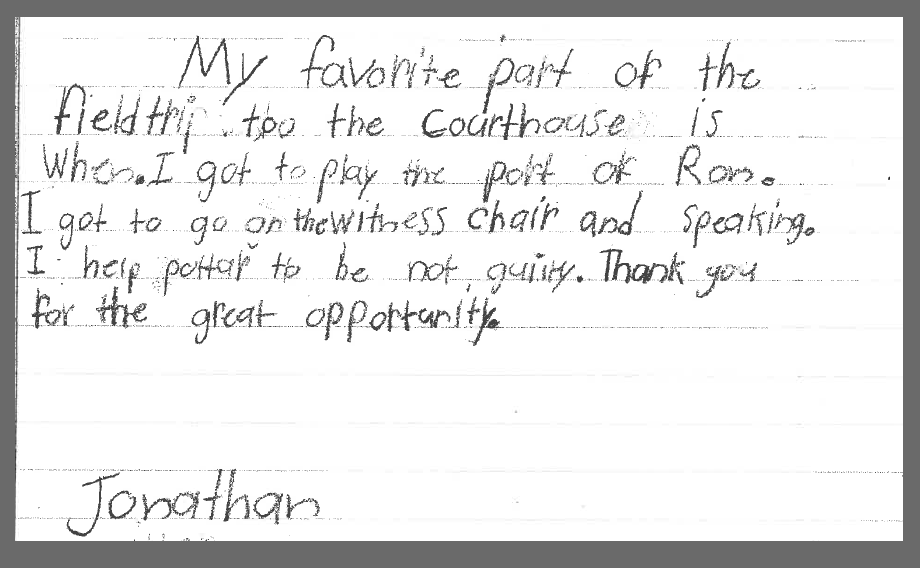 My favorite part of the fieldtrip to the courthouse is when I got to play the part of Ron. I got to go on the witness chair and speaking. I helped Potter to be not guilty. Thank you for the great opportunity.