Jokers, Hate Crimes, & You: When The ‘Joke’ Isn’t Funny
Bad Joke Actually a Hate-crime When
Student Lists Two Others as ‘Slaves for Sale’ in Florida
Pictured: A screengrab showing an offensive ‘joke’-post to the website Craigslist in which two high school students were shown under the headline ‘Two Slaves for Sale’.
No matter if something is done with an intent to hurt someone or just casually as a joke, if one person’s simple fun results in another person’s harm, that action may be considered legally as an act of bullying, criminal harassment, or both. Obviously being the victim of bullying is never fun. If that fact is not enough to stop someone from reconsidering their actions, they should keep in mind that unintentional harm is still harm in the eyes of the law. Consider this incident:
A student at a Florida’s Fleming Island High School (who remains unnamed due to his age), took a picture of two African American females in his class and then posted an ad featuring that picture on Craigslist. The ad had been placed in the ‘Home and Garden’ section of the used goods website and had been titled “Two Slaves for Sale,” [as seen in the picture above].
The post went viral overnight as hundreds of complaints were made on social media. Reports say that the high school student responsible for the ad was identified and then immediately expelled from school and sent to an alternative education program offered by his district.
The post however, was not the first incident involving heavy racial ties for the Fleming Island High School. The school’s students had been reporting issues and incidents of “racial targeting” on their campus (by fellow students and by school staff) for years before the craigslist incident took place.
One of the students pictured in the ad, Skye Fefee, told reporters that she was deeply disturbed by the act and wondered how something like this could happen not only to her, but those around her too.
Regarding the school administration and how they handle racial incidents including her own, Fefee stated “The administration doesn’t pay attention to this. They need to better monitor the students,“. She went on to state that her school’s administration needs to be more proactive, taking steps that prevent students from being hurt by those committing acts of hate.
The student responsible is a juvenile and wasn’t charged with any crimes.
Despite being a juvenile, the student responsible for posting the advertisement to Craigslist was lucky to have not been charged with a crime. Some districts would find the student criminally liable for bullying, and if the school was federally funded the student could have been risking facing federal hate crime charges (no matter his age).
—————————-
Questions:
1: This article talks about an issue involving hate speech. Should the first amendment affect hate speech? Why or why not?
2: If you or someone you know was targeted in a “joke” like this, what would you/how would you stop it?
3: Do you think the first amendment protects too much? What changes would you make or not make to the first amendment?
4. If this event had happened at your school, what are the minimum and maximum penalties the student would have faced at your school for posting that kind of hate-ad to Craigslist?
5. If this event had happened at your school, what are the minimum and maximum criminal penalties the student would have faced for posting that ad?
Giraffe populations have dropped dramatically in the past twenty years, in fact in Northern Kenya the population has dropped by over 70% in the past two decades. Researchers have been working at finding a solution to decrease the rapid rate that giraffes are decreasing in population size. The road to that starts with observing the giraffes.
The status of the giraffe population has placed them on the International Union for the Conservation of Nature (IUCN) as Vulnerable and on the IUCN Red List of Threatened Species.
Poaching, habitat loss and disease has made them extinct in seven African nations. For a species that once had over 160,000 in 1985, there are less than 100,000 remaining. In the sub-Saharan desert, the extinction of the giraffe has gone largely unnoticed.
This is where you come in.
The researchers have set up an online site where users actively stream the footage and help the researchers make observations. This is a great way to make a global impact without having to leave the comfort of your own home. The crowd sourcing project invites the public to help organize the data, which is vital to the success of the conservation projects.
Those projects also provide people to actively engage in the protection of endangered species. More than 1 million images from the motion-activated camera in Kenya have assisted the researchers in cataloging each image and identifying and counting the animals caught on camera.
“Community conservancies are where we are seeing strong signs of hope with increasing giraffe population numbers and we are working hard to support those conservancies”, said David O’Connor, researcher and conservation ecologist for the San Diego Zoo.
1) This volunteer opportunity is one that can be fun and really convenient at the same time. Now it’s your turn: Come up with your own idea for a unique way to make the world a better place like this one! What is your idea, and how would it work ?
2) If you have already heard of other opportunities like this one – something fun and easy that helps make a big difference, what was it and what about it seems fun to you? If you haven’t heard of other ‘fun’ volunteer options, go searching online for ‘fun easy volunteering’ opportunities, and then report back: What is one opportunity you found that you would be willing to do, and what makes it so appealing to you ?
Are your mobile phone’s apps listening to you? You might not think so, and yet a recent article on Wired.com reports that there’s a good chance your phone is listening to you right now as your read this article
Disclaimer: If you are reading this in Project REAL’s App, rest assured we are not listening to you, and encourage you to check our app’s permission settings in your phone if you would like verification.
According to the article, a large amount of the most downloaded apps in the iTunes, Google Play, and Windows Apps stores require users to grant them permission to access a phone’ s microphone. This permission is then used by the app to listen for ‘ultrasonic beacons’ – sounds the human ear can’t detect that trigger a reaction in the app. If you’re familiar with Shazam, imagine if you were home listening to music while doing your homework and you opened the app to find it had not only recorded every song that played while you listened, but ordered those songs from an online music store!
To some this revelation is concerning, though to others it just doesn’t matter. Perhaps you don’t mind if a McDonalds app hears an ultrasonic frequency that lets it know you skipped school to catch a matinee of the new movie you’ve been dying to see. Perhaps they’ll use that information to decide to partner with the film’s producers if there’s a sequel. What if you have an app from your workplace on your phone and it tells your employers you were at a movie on a day you called in sick? Suddenly, the thought of your phone listening for ultrasonic beacons without your consent each time becomes rather frightening, doesn’t it?
————————– Questions:
1) Why should there be or not be laws preventing these techniques?
2) Why Should consumers have a right or not have a right to be notified every time an app wishes to listen for beacons?
3) Why should there be or not be time limits (where an app can only listen for so much time after each authorization to do so)?
Be sure to provide full explanations for each of your answers. For more details, you can read the article this piece was sourced from here::
Woman Sues Over Too Much Air in Candy? Yes, Really!
Do you find yourself at the movie theatre paying what seems like 4x the price for candy than what you would pay for it at a convenience store? Do you get even more frustrated when you open that candy up and find that the box was much larger than it needed to be for the contents inside?
Well, one woman had enough with what she felt was a 50% candy, 50% air ratio in her box of candy! She is suing the makers of Mike & Ike’s for false advertising. Rather than sue the movie theatres (which don’t package the candy), the woman decided to go straight to the source and sue the candy’s producers. While it’s not a criminal matter, if the company is found to have deceptively advertised they may face legal consequences beyond any decision which may be handed down in civil court.
While the story is fun and a bit goofy (it is a story about a lawsuit over candy after all), it also highlights the importance of understanding that courts aren’t just for criminal law – civil law is a big part of court too.
If you’ve been wronged in a situation, would you know if you could sue to be ‘made whole’? The courts exist to help society maintain fairness among its members, but they can only be put to use if the citizens know how to utilize legal services.
Questions:
1: Even at a movie theatre, a box of candy won’t cost more than $10. In many states, to file a court case you have to spend around $30 just to file paperwork that launches a court case against another person. Even after you file, it can take months before a case ends up in a courtroom! What are some reasons this woman would have taken the time to sue the candy company?
2: It seems like a person can be sued for anything these days! Why do you think that is fair or unfair?
3: Lawsuits in civil court (where people sue each other) tend to happen when two people do not agree on something. No one goes to jail just because of a lawsuit in civil court, but money can be awarded to either the person suing (the plaintiff) or even the person being sued (the defendant) if the court thinks the lawsuit was just wasting the defendants time and money. Given those conditions, imagine a situation that you don’t think a court would bother hearing (meaning someone would file a lawsuit, and a judge would say ‘sorry, the court will not be having this lawsuit be a ‘court case’), and explain why the court would decide not to hear the case.
FAA Investigates Harrison Ford After He Flies Over Jetliner Awaiting Takeoff
You might be able to complete the Kessel run in less than 12 parsecs, but that doesn’t mean you’ll outrun the Federal Aviation Administration’s ability to enforce laws and regulation!
In February of 2017, NPR reported that the FAA would be investigating Harrison Ford for flying his plane over a jetliner that had been waiting to takeoff – a violation of FAA safety procedures. The incident occurred as a result of Ford landing on the wrong runway. While he may have played a rebel-with-a-cause pilot that got away with everything in Star Wars while acting in the roll of Han Solo, in real life Mr. Ford is as subject to the law and FAA procedures as much as any other pilot.
————————– Questions:
1) What’s a story you recall where a celebrity had a run-in with the law?
2) Did you think the person received special treatment or harsher treatment because they were celebrities?
3) Sometimes, people may be ‘made an example by a court – after they are found legally responsible for a crime and when their punishment is being decided, a judge may decide to ‘send a message to the community’ that a type of crime will not only be illegal, but punished harshly. Then, the give the person the biggest punishment possible (there may still be limits to what the punishment can be based on the laws around the crime being punished). Sometimes this can happen to famous people. What do you think: Why is it far or unfair to let a person’s fame influence the size (scope and intesnsity) of their punishment?
Learning Together:
What Are Social Host Liability Laws?
Did you know you can get in trouble for what people do after attending a party you’ve thrown? A California court found the young host of a party liable for the death caused by one of his party’s attendees who had been drinking.
Andrew Ennabe was a 19-year-old college student who was killed by a drunk driver in 2007. The drunk driver was Thomas Garcia. On the night in question, Mr. Garcia became intoxicated while drinking at a house party in Diamond Bar CA in 2007. Now he is currently serving 14 years for manslaughter.
Andrew Ennabe’s family sued the party host, however the original California court in which the case was heard dismissed the case on the grounds that Ennabe’s family hadn’t proven the party host’s responsibility in the matter. After the case was appealed, California’ s Supreme Court found that the case should be heard by the lower court under California’s social host liability laws.
While California may have a reputation for ‘progressive’ laws and the party host may not face criminal consequences in this particular case, the variety of cases which make their way through civil courts is plentiful. While you should always consider your actions from ethical and moral standpoints, the legal consequences of the choices you make should also be a consistent factor in your decision making process.
Whether you are a teen heading off to college, a recent graduate with a close call, or a parent worried for your student now that they’re living away from their childhood homes, we encourage you to share your experiences and thoughts on this matter in our comments section.
————————– Questions:
1) What social-host liability exists in Nevada? Is there criminal, civil, or both?
2) What is a situation you have been in where someone (maybe even you) could have ended up in trouble because of a ‘social host liability’ legal consequence?
3) Other than holding a house party where underage people drink (or do drugs), now that you are almost 18 or having reached the age of 18, what is a situation that you could easily find yourself in where you or a friend could end up in trouble for ‘social host liability’ reasons (Imagine if you ‘go off to college’ – what could happen there)?
4) In context to your response to Question 3 above, what do you plan to do to limit your criminal and civil liability under ‘social host’ conditions once you move out and start living on your own?
Be sure to provide full explanations for each of your answers. For more details, you can read the article this piece was sourced from here::
99 Year Old Woman Arrested…
Because She Requested It!
At Project REAL, we provide field trips to Nevada’s courthouses for our state’s students. Most of those students get to witness people in custody as they watch live criminal calendars where they also get to learn the consequences of being involved with criminal activity. On rare occasions like slower days where there’s no appropriate criminal calendars for the students to watch, a bailiff or marshal will explain their work by demonstrating on a student and putting them in handcuffs! While it’s fun, none of the students actually want to be arrested during their field trip (or any time after).
That wasn’t the case for one 99 year old woman from the Netherlands named Annie, who’d had ‘getting arrested’ on her bucket list (meaning it was one thing she really wanted to do during her lifetime, but hadn’t done yet). Annie was just very curious about what it was like to spend time in a jail cell. After hearing of her request, the local police department worked to make her dream come true: They decided to show up and arrest her (with her families support – she wasn’t surprised so that she wouldn’t be scared )! While Project REAL does not condone the desire to be arrested, we certainly support the work of local law enforcement agencies that find fun and engaging ways to interact with their local community.
———- Questions:
1: Even though the lady was ‘arrested’ (they didn’t actually give her a criminal record), this was meant to be a good thing for the community – the police wanted to show they could help people have ‘fun’ by fulfilling this very weird wish. Why you think this was or was not a good thing for police to do?
2: Whether or not you think this was a good way for police offers to engage with the public (show who they are and just ‘talk’ to people instead of only speaking with them while enforcing the law), what are some things they could do that you would think are good ways to do that, and why would you suggest those actions / activities?
3: Why would you want or not want to be ‘play arrested’ for a day?
For Hollywood stars, death might not be the end of their career. In the last couple of years movies have remastered deceased actors and actresses but, can they do that? What are the laws behind using someone’s image and voice after they’ve been long gone?
Perhaps you’ve seen Star Wars: Rouge One. Or maybe you watched the original film The Crow. In both these films, the likeness of actors who were deceased (in one case for several years and the other for just several weeks) were used after their deaths. Even concerts are using holographic technology and past recordings to put on shows using deceased musicians (with Tupac and Michael Jackson being famous and somewhat recent examples of this technique).
As digital manipulation technologies improve, so does the entertainment industry’s ability to use a performer’s likeness after his or her death. In some instances, the performer designated ownership of the rights to family members or their estates. In other cases, no clear guidance has been provided as to how their likeness may be used after a performer has passed away.
————————– Questions:
1) What do you think about companies using people’s likeness after they have deceased?
2) Why should their or shouldn’t there be laws requiring ‘designated consent’ before these methods are employed (meaning there needs to be laws that require a person to agree to their image being used if they die, and that no more projects like the ones in the story could happen until such laws were created to restrict that practice)?
3) What if movie studios start requiring performers to authorize use of their likeness after death – should there be limits to what requirements can be included in a performer’s contract?
Author Reece Jones’ book ‘Violent Borders: Refugees and the Right to Move” argues that by removing borders, people have more access to human rights. On one hand, this certainly can make sense: Without borders, people can travel freely and escape from living under governments they are scared of. On the other hand, borders can help preserve cultures and societies.
Consider the United States: within the US are 50 states each within their own borders. The country has a set of laws that apply to all citizens at all times. Each state then has it’s own set of laws that may be different from the state next-door to it. Those state laws reflect the residents’ values while the country’ s laws reflect broader values of the citizens of the nation.
Jones’ claim that less borders increases access to human rights is an interesting one that is sure to spark differing opinions. This is… well, it’s an interesting idea! It’s also sure to stir debate – possibly even in your classroom!
————————– Questions:
1) Without borders, where would one state’s laws end and another begin?
2) How would you even know what state you are in?
3) What are your feelings about Jones’ idea? Why do you think it would or would not work? What effects do you imagine it would have?
Be sure to provide full explanations for each of your answers. For more details, you can read the article this piece was sourced from here:
Two 19-year-old Girls Arrested After Burning Down a Stores Trump Sign
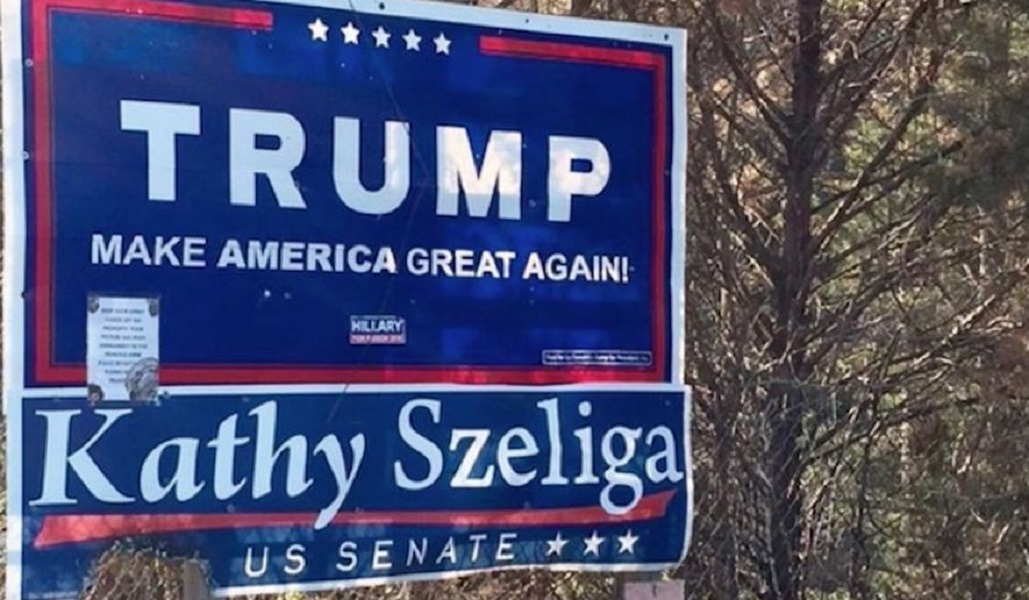
Pictured: The Trump sign outside of Wink’s Sporting Goods before it was set on fire
Americans tend to have strong political views either being very conservative or very liberal. Around the time of an election, or even well before or after some people like to advertise their political views by hanging flags or putting bumper stickers on their cars or putting signs out. A small sporting goods store in Maryland did just that.
Wink’s Sporting Goods is a store that supports Donald Trump and proudly shows that by displaying a Trump sign outside of their store. Son of the owner, Jamie Wink, says they do it to get more business, finding that more people come into their shop after knowing that they support Donald Trump.
Well, back in April 2017, a few months after Donald Trump went into office, two 19 year old girls D’Asia R. Perry and Joy M. Shuford were arrested and charged with arson and committing a hate crime for setting Wink’s Sporting Goods sign on fire. The fire set by the two girls burned down the sign and some nearby plant life but did no damage to the store.
Perry was the driver of the getaway car and Shuford was the one that hopped out quickly to set the sign ablaze. Perry was identified as the driver of the car after police tracked down the car seen on surveillance footage. Shuford turned herself in after hearing of her friend’s arrest. Before admitting to the crime, Perry had originally told police that Shuford’s name was April then changed her story saying she didn’t know her at all. They two were later released on an unsecure $20,000 bond.
————————–
Questions:
1. Would the consequences be different if Perry and Shuford were under the age of 18? How? What about in Nevada?
2. How could lying about Shuford’s identity affect the consequences for Perry? Would it be better to turn her friend in? Explain.
3. The two girls were charged with arson and committing a hate crime among other charges unnamed by the article. What other charges were they possibly charged with? Would they change if this happened in Nevada?
4. Are the consequences different for the person driving the car and the person committing the crime? Should they be? Why or why not?
Be sure to provide full explanations for your answers. For more details, you can read the article this piece was sourced from here:
Thank you for letting us watch the civil case! It was cool because it was a real case and not one played out. I had a lot of fun watching the other kids act out a session. Thank you for your time.
- Kaylie [Hewetson Elementary - Grade 5]
Project Real
2020-12-11T20:39:35+00:00
Thank you for letting us watch the civil case! It was cool because it was a real case and not one played out. I had a lot of fun watching the other kids act out a session. Thank you for your time. - Kaylie [Hewetson Elementary - Grade 5]
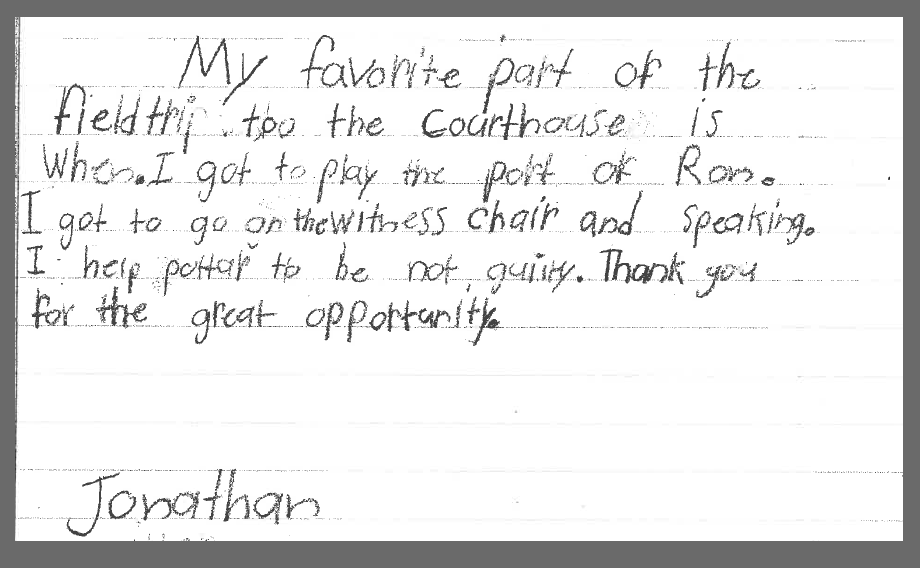
My favorite part of the fieldtrip to the courthouse is when I got to play the part of Ron. I got to go on the witness chair and speaking. I helped Potter to be not guilty. Thank you for the great opportunity.
- Johnathan M [Harmon Elementary - Grade 4]
Project Real
2020-12-16T21:47:04+00:00
My favorite part of the fieldtrip to the courthouse is when I got to play the part of Ron. I got to go on the witness chair and speaking. I helped Potter to be not guilty. Thank you for the great opportunity. - Johnathan M [Harmon Elementary - Grade 4]
Thank you for letting us experience court for the first time. It was the best experience ever, thank you for everything. You really made me think about being a judge. Thank you
-Mina L [ Twitchell Elementary - Grade 5]
Project Real
2020-12-16T22:04:09+00:00
Thank you for letting us experience court for the first time. It was the best experience ever, thank you for everything. You really made me think about being a judge. Thank you -Mina L [ Twitchell Elementary - Grade 5]