U.S. Lawmakers Seek to Criminalize
Boycott Campaign Against Israel
Within the last year, there has been a rise in political speech and activism towards many momentous events, such as North Korean conflict, same-sex marriage, to Twitter going beyond 140 characters! In relation to this article, a group of senators wants to implement a law that would make it a felony for Americans to support the boycott against Israel, resulting in a maximum criminal penalty of $1 million and 20 years in prison.
Why is there a boycott on Israel and why is it becoming an international movement?
According to a Time article, the boycott movement was started by the Israelis-Zionist (a person who believes in the development and protection of a Jewish nation, Israel) liberals who support Israel’s existence on land it won in the 1948 war, but with Israel’s occupation in Palestinian territory in 1967, the Israelis wanted to boycott goods produced by Israeli companies (that operate on Palestinian land). Over time, this situation gained different opinions from other countries. Some felt sympathetic towards the Palestinians while others were in favor of Israel.
For more information regarding the history of the Boycott campaign, click here!
Which leads us to the boycott movement today. Around the world, people are expressing their avoidance of Israel and are getting punished for it. For instance, in France, activists have been arrested and prosecuted for wearing T-shirts advocating a boycott of Israel. In the U.K., has enacted a series of measures designed to outlaw such activism. Leading into the United States, U.S. governors are trying to impose strict regulations of any boycotts aimed even at Israeli settlements. In July 2017, a group of senators wants to implement a law that would make it a felony for Americans to support the international boycott against Israel. But, people have questioned that penalizing boycotting may infringe upon the first amendment’s freedom of speech and protest.
————————– Questions:
1) How does this violate or how does this not violate the right to freedom of speech granted by the First Amendment?
2) How does this violate or how does this not violate the right to freedom of speech granted by the First Amendment?
3) Why do you think boycotting as a form of activism should or should not be a felony offense?
4) Some critics of the attempted boycott ban argued that this type of ban would not be attempted if it was any other nation allied with the United States, and that Jewish and Christian lawmakers have suggested the ban because of religious beliefs rather than out of national security concerns. Remember: the First Amendment suggests there should be some separation of church and state, but how that separation should look has led to many legal battles throughout American history.
With those observations in mind Why do you feel that it is acceptable or unacceptable for lawmakers to make decisions based on their own personal beliefs when serving in government, and
5) How are your feelings (as explained in response to Question 4) supported or not supported by the wording of the First Amendment, and what precedent-setting legal decisions support your response?
Be sure to provide full explanations for each of your answers. For more details, you can read the article this piece was sourced from here:
A 2,000-year-old terracotta warrior from China had one of its thumbs stolen while in an American museum. The suspected thief was caught on camera sneaking into the warrior’s exhibit, taking a selfie with the statue, and then breaking off its thumb. The camera then caught him pocketing the terracotta thumb and taking it.
Not important but also interesting: the thief burgled the museum during an ugly0-sweater party being held there!
On the way home from the party, a suspect named Michael Rohana bragged to his friends about successfully stealing part of a warrior. A month later the FBI went to his house and questioned him which lead to the return of the missing thumb. As a result he was charged with multiple crimes including “concealment of an object of cultural heritage stolen from a museum” (meaning that he knew the thumb was stolen from the museum yet he kept it like it was his own belonging.)
The warrior statues were discovered by a Chinese farmer in 1974 but originally date all the way back to 209 BC. Sculptures like the one that had its thumb stolen were created in order to protect the tomb of China’s first emperor. At the time of the theft, the statue was worth $4.5 million. Additionally China has to send two experts to the United States to try and repair the thumb.
Chinese officials and citizens are upset at both the museum and the United States for the lack of security for the sculptures and for failing to protect the warrior from harm. Users of China’s Facebook-like service Weibo left critical comments about the incident, including one user who noted that the warriors “are kept far away from the public” (in China) and asked “How come the sculptures in Philadelphia are not displayed inside glass cases?”
The man – Michael Rohana – made a quick decision to mess with the terracotta warrior’s display to try and impress his friends. Now he has to face consequences starting with going to court, though he’s likely to face much worse than that!
————————– Questions:
1) Given the fact that the damaged item was originally worth $4.5 million and that the thumb portion of it was taken illegally, what are the lowest criminal charges or consequences the suspect can face (if they were charged in Nevada)?
2) The artifact was being borrowed while it was damaged. If China decides to take action against the US, what court would the case be taken to (China’s? American Federal Court? An American State Court?) and what charges could the US government face, if any? If not the government, who would end up in court and why would it be a criminal or civil case (pick one or the other and explain why you chose that way)?
3) Everyone know of someone (maybe even themselves) who’ve just done what the thumb-thief did: failed to think about the consequences and just quickly acted on an impulse. What is something you saw – or even did – that could have resulted in a lot of big trouble all because you or that person you saw just didn’t stop to think, and then act? What could the consequences have been?
The right to vote is a given liberty to all U.S citizens. This said anything given can be taken away. A felony conviction can cause a citizen to lose this precious right. In Florida, felons who have served their time have struggled to obtain their voting rights back. After taking their fight to Federal Court, things may have gotten better for people who’ve paid their debt to society.
Before the federal lawsuit, Florida’s felons would have to go before an Executive Clemency Board and request that their voting rights be restored. Despite being a voter-elected position, Florida’s Governor is one of the people who have a seat on the state’s Executive Clemency Board.
Governor Scott had been the head panel member of the Board by nine people with past felonies. They decided to sue for their rights back, and used one incident in particular to make their case:
At one point, Scott had restored the voting rights of a white man who had cast an illegal ballot in 2010 (an election during which he had voted for Scott – or so he claimed during the hearing which the Governor was present at). Around the same time, Scott had denied five other requests, with four of those requests coming from African-Americans. With Scott being a touted-Republican and most of Florida’s African Americans being registered Democrats, the Governor’s judgment and use of power were brought into question by the lawsuit.
Politics aren’t supposed to play into the decision to restore voter rights. Florida’s intended design of the system was one where the Clemency Board reviews applicants eligible for restoration based if they pass the criteria. Eligibility is available five years after completion of a sentence with full payment of restitution. Soon after the Office of Executive Clemency inspect the applicant and decide from a range of factors the possible acceptance of restoration.
U.S District Judge Mark Walker’s questioned Scott’s “unfettered discretion in restoring voting rights”. The Judge’s decision in Federal Court ruled Florida’s right restoration system in violation of the 1st and 14th amendments. Now as a result of the lawsuit, Governor Scott is the state’s first to have restrictions placed on his role in restoring felons’ rights to vote.
In defense of Florida’s practices, Scott’s communication director stated: “The discretion of the clemency board over the restoration of felons’ rights in Florida has been in place for decade[s] and overseen by multiple governors.”
Florida’s restoration system will now undergo changes as a result of Judge Walker’s ruling, and the nine people involved in the lawsuit will once again be able to attempt to restore their voting rights.
———————– Questions
Part one:
1) Nine people who filed this case to report issues with the process of rights restorations in Florida. They didn’t believe in the justice of that system, and the judge ended up ruling in their favor. In his decision, the judge cited Florida’s state government for violating the 1st and 14th amendments which lead to his final decision.
1.a) In what ways could Florida have violated these amendments? Do you agree or disagree with the Judge’s claim that these violations occurred?
1. b) The nine people were also burdened with the financial cost of paying for their case. Are they eligible for any kind of compensation for the expenses they took on, now that the case seems to have been decided in their favor? Tell us what laws support your answer.
1.c) The federal court had to intervene to establish balance for the restoration process in Florida because of the potential bias a governor may have. With this restriction in place, how much authority does Florida have when it comes to returning right to their citizens, and is that too much or too little authority for the state to have?
Part two:
2.a) A 2016 survey led statisticians to estimate that 1.68 million Floridians had lost their voting rights. These statistics differ around the country. How many people in Nevada have lost their voting rights this year so far, and what about in the past 10 years?
2.b) How would someone in Nevada get their voting rights restored and how is that process different than the one in Florida?
Part three:
3) As you’ve just learned, a citizens lose certain rights after being convicted of a felony. Once they’ve served their sentences, many of these people try to reform their lives to become better than they were before. Even though they’ve ‘served their time’, some will continue to experience ongoing punishment when some of their rights remain revoked (until they take additional steps to have some of those rights restored). Does restricting felons’ rights after they’ve served out their sentences do enough to help them learn from their mistake, or does the policy of not instantly restoring their rights (like the right to vote) after they’ve been released from prison go too far? Explain your reasoning!
Fashion designers often have a unique distinction on their products- a look or style that they are known for- and Christian Louboutin (pronounced LOU-EEE-BOO-TAWWWWN) is no exception. For over 25 years Louboutin has made the bottoms of his fancy dress shoes an unmistakable vivid red. Now there is question of whether or not he can trademark the color. His company had even trademarked “the color red (Pantone 18 1663TP) applied to the sole of a shoe” (like the shoes in the picture above).
In 2012, his company filed a lawsuit against Dutch company Van Haren that had started selling high heels with red soles similar to his. Louboutin filed the lawsuit claiming that the shoes “infringed on his brand’s trademark for footwear”, (meaning the red soles on fancy dress shoes).
The other company (Van Hare) was forced to stop selling their red-soled shoes after Louboutin sued them for trademark infringement. However the brand’s lawyers weren’t having it, and fought the case until it reached the European Court of Justice (meaning the case was heard by several lower courts first).
Under European Union law, shapes typically cannot be trademarked (so the design of a shoe might not be able to be legally protected, but a specific logo of a company still could be). According to a court official, Louboutin’s red soles are part of a shape (and not something like a logo). Because of the rules about shapes, his request for trademark protection could be refused.
Fashion designers fighting over colors in court might seem very European, but America has seen its share of legal battles over colors too! For example, in 2014 the United States Federal Court decided that AT&T was no longer allowed to use certain shades of pink after a lawsuit with T-Mobile.
AT&T had come out with a new service called Aio wireless that used a shade of plum in all of its advertising. While it wasn’t the exact same color as T-Mobile’s better-known magenta, it was close enough for a lawsuit to be filed by T-Mobile (and won).
————————– Questions:
1) No matter how the court case turned out, why should Louboutin be able or unable to trademark soles of shoes with a specific shade of red?
2) What if Nike made a sweet pair of red-soled running kicks: Should Louboutin be able to sue Nike if they did that – why or why not?
3) After considering & answering #2’s question about Nike shoes, answer this: What if Nike released a pair of red-soled running kicks and called them “Louie’s Batons” – as a way of saying Louboutin is wrong: almost like a protest to the lawsuit in Europe. If they did that, why should they be allowed or not be allowed to sell the shoe in those circumstances?
Is Your Antivirus Tracking You?
You’d Be Surprised At What It Sends
In a society based around computers, we entrust these devices a lot of personal and professional data. To maintain these valuable items, we entrust companies such as Avast, AVG, Kaspersky Lab, McAfee, Webroot, and other antivirus companies to not only protect our computers from malware and viruses but to also maintain a level of privacy when accessible to them. In a recent report from AV-Comparatives (an antivirus testing and comparison organization), they found that your antivirus product may have a list of web pages you’ve visited along with your sensitive personal documents!
Released in May 2014, AV-Comparatives performed a study that analyzed the antivirus products running in the background of a computer and what they sent to the antivirus company. Another aspect they inspected was the End User License Agreements (EULA) that many users, like myself, neglect to read. Lastly, a questionnaire was sent to antivirus company, so they can fully explain the extent of their products and their purpose.
As a result, companies answered with unfitting answers that contradicted what their products actually did! For instance, some companies will assign your system a unique identification number and transmit a list of visited websites, whether they are malicious or safe. Companies can also transmit your computer’s name, local IP address, language, running processes, and Windows username to the antivirus company. More importantly, these companies can also access documents or sensitive items that may be private for you, if they deem it as ‘suspicious’.
With this situation being an issue of privacy, there are a few laws geared toward cybersecurity and privacy. The Electronic Communications Privacy Act (ECPA), passed in 1986, allows the U.S. government to access digital communications such as email, social media messages, and information on public cloud databases. With a subpoena, the government is allowed to access more information. This can apply to different companies, such as Google, Facebook, Avast, etc.
A more recent law that has passed was the Children’s Online Privacy Protection Act (COPPA). Originally passed in 2000, it was the first U.S. privacy law written for the internet. Implemented in 2013, It requires websites that collect information on children under the age of 13 to comply with the Federal Trade Commission (FTC). The FTC is a federal agency that administers consumer legislation and ensures a fair and free commerce. The purpose of this law is to determine whether a website is geared towards children by reviewing its content, graphics, audience, language and features, and advertising. This law can also collect information from children, whether websites’ operators intentionally or intentionally do so.
Lastly, in Nevada, NRS 603A- Nevada Personal Information Data Privacy Encryption Law was passed in 2010 to mandate customers’ encryption and stored personal information. This primarily applies to business who collect personal information but requires them to encrypt any and all personal information that is given to the company by the customer.
————————– Questions:
1) Do you think that sending of personal information/files should be pointed out/requested during setup, or should it remain disclosed in the EULA?
2) Should companies specify what they do with the information and how they dispose of it?
3) Should the government impose limitations to accessing sensitive information?
Be sure to provide full explanations for each of your answers. For more details, you can read the article this piece was sourced from here:
Controversial White House Tape & Records…
In 2018!?
One of the things the 1969-1974 Nixon Presidential Administration will always be remembered for are the controversial tape recordings made in the Whitehouse. Now thought of as a matter of history, at the time the taped recordings made at the White House were highly controversial. These taped records of conversation in the White House are credited as having played a major role in the resignation of President Richard Nixon.
Given all of that history, a situation where tape, record, president, and white house can be used in the same sentence is one that most administrations would try to avoid. The 45th president of the United States however has a reputation for doing things differently, which may be why we have this interesting story to share with you:
The Presidential Records Act of 1978 states that all presidential records must be preserved. You may not be familiar with the law, since you’re not President of The United States. So, you know – that’s fair.
When someone is elected to the Presidency of the United States for their first term, there’s a transition period during which they are taught about policies, procedures, and laws they need to abide by.
Despite measures like the briefings given to a president-elect, President Donald Trump apparently has a habit of ripping up things like notes, memos and other papers when he has finished with them. White house staffers have reportedly been taping these documents back together after the President has torn, ripped, or shredded them so that the administration remains in compliance with The Presidential Records Act of 1978.
Invitations, letters and newspaper clips with notes are regularly torn up by President Trump. Clear scotch tape was given to employees to piece the ripped documents back together. One employee who was fired early on in 2018 that had claimed he put papers back together on the job said “We’re making more than $60,000 a year, we need to be doing far more important things than this. It felt like the lowest form of work you can take on without having to empty the trash cans.”
The employee who was fired claims that when he left the office, employees were still regularly engaged in the practice of taping documents back together. Some White House staff called the ripping habit Trump’s ‘unofficial filing system.’ The White House had no comment on the situation when asked.
————————– Questions:
1) In America, no person – including – the president is not above the law. Everyone needs to #PlayByTheRules. That being said, if the documents are able to be pieced back together, does President Trump’s tearing up documents count as ‘document destruction’? Could it be successfully argued that tearing up documents is just a really bad system of organization that makes records preservation harder?
2) What if the president were to go further though? Imagine instead of liking to tear up documents when being done with them, a president preferred to set them on fire. Clearly then, the document would be destroyed. What would the legal consequences be for violating The Presidential Records Act of 1978?
3) Pick a side: Do you think that there are any laws a president should be exempt from?
– If you agree: What laws should a president be exempt from, and what are the reasons for exempting the president?
– If you disagree: Why should the president have to follow the same laws as everyone else? Are there benefits, and if so what are they? Is is simply to avoid risks, and if so what risks are being avoided by making presidents follow every single law that everyone else has to follow? Give a thoughtful, detailed, response!
Be sure to provide full explanations for each of your answers. For more details, you can read the article this piece was sourced from here:
https://www.politico.com/story/2018/06/10/trump-papers-filing-system-635164
Contributed by- J. Plummer
Welcome to Volcano Land:
Your New Home (Maybe?)!
Hawaii is known for a number of landscapes like beautiful beaches and volcanoes (including three active ones!) With one currently erupting there is a great chance that lava could reach the ocean. When it reaches the sea, the lava cools down and hardens creating more land called lava extensions.
This geological event leads us to a pretty interesting legal question: Since it was created by a natural event, who exactly owns this new land? Before we look for an answer, let’s get some background on where this debate began:
In 1955 a volcano called Kilauea erupted and created over 7.9 acres of new land. A local family purchased previously-existing land next to where the lava extension had formed. The new owners assumed that they had full rights to the recently created parts, and not just the initial land they purchased. They even paid property taxes and planted trees on it!
Following an eruption in the same area in 1960, the issue of who the land really belonged to ended up being taken to court. Hawaii’s State Supreme Court ended up ordering the land owners to leave the lava-extension, and then issued the land-rights for the lava extension to the state.
The court ruled that the land created by the volcanic activity was for the “use and enjoyment of all the people”; instead of only allowing one family or person to use the land as they please, everyone gets to use it!.
Since the court ruling established that land created by lava belongs to the state, that meant that all of the land created by Kilauea’s eruption in 1955 belongs to the state of Hawaii. As a result, it was not just the one family and their bit of land that was affected by the court case’s outcome.
————————– Questions:
1) Do you feel like the court ruled the right way? In other words, should a person who lives near lava-created land have the first chance to purchase it from the state before the government can decide to do something else with the new property? Would your opinion change if person wanting to purchase the lava-extended land lived in a house 20 feet away? Would it matter how long they’d been there – say….6 months….or 20 years?
2) In consideration of the questions brought up in number 1 above, tell us why you think the court ruling is or is not good enough, and why there should or should not be specific-laws be created to manage lava extensions in Hawaii ? Just for context (there is no right or wrong answer, so this isn’t a hint): There is A LOT of volcanic activity near Hawaii. It doesn’t always create land, but it could. How that fact influences your answer is up to you!
3) What about the government though? Hawaii’s State Supreme Court ruled the land was created for the “use and enjoyment of all the people”. Based on the wording of the court ruling, should the government be allowed to sell the new land to a business or individual, or should it be forced to use the land for a park, community center, or something along those lines? Tell us what you think and why you feel that way.
Somebody Toucha My Spaghet! Police, Pasta, & Problems
Spaghetti & meatballs is a common dish that satisfies people’s hunger across the globe. Popular as this pasta dish might be, one man’s craving for the staple food led him to end up in some hot water… with the law!
A man in Pennsylvania was craving the classic dish so much so that he broke into someone’s home and stole a pot of meatballs and sauce ( a crime in itself – meatballs and sauce with no carbs?!? Get over yourself man!).
The victim (the person whose house was broken into) said he came home to the man in front of his house covered in red sauce. When he went inside he noticed the pot of meatballs with red sauce he’d been preparing was missing, and so he called the police.
The police arrived at the scene and began following up leads, since the suspect who had since ran off. They eventually found him at his home – in the next city over – with his face and clothing still covered in the sauce from the pot!
The thief was charged with burglary, theft by unlawful taking, and criminal trespassing (when you enter somebody else’s property without their permission). On top of all those charges related to the theft, he had already been “wanted on a warrant for failing to appear for a prior incident”.
———————— Questions:
1: What penalties could the thief face for the theft by unlawful taking charge?
2: What penalties could he face for the burglary charge?
3: What penalties could he face for the criminal trespassing charge? As you answer these questions, keep in mind that the level of consequences people face relating to theft and property damage can be tied to the value of the property that was damaged or stolen.
4: How much is a pot of meatballs and sauce worth? Do you count the time that goes into preparing the dish? Cooking is an emotional process for some people – does that increase the value? Give us a few ideas of how you would account for the value of the stolen (and technically, destroyed) property. Then, let us know if the changing value leads to a higher possible maximum penalty under the law! Bonus points for those of you who reply with the punishments in Nevada compared to those in Pennsylvania, where the pasta sauce was pilfered!
Internet celebrity Grumpy Cat should be doing anything but frowning after receiving over $700,000 in a lawsuit.
The frowny feline known as Grumpy Cat’s rise to popularity began in 2012 when her down and dismissive attitude won over the hearts of the meme market. Grumpy Cat’s stardom prompted her owner to monetize on that success, so she started Grumpy Cat Limited. The potential for profits from the sourpuss generated licensing deals with numerous companies. One of those companies was Grenade (a beverage company).
Unfortunately, a licensing deal between the two companies to allow for the creation of iced coffees called “Grumpy Cat Grumppuccino” did not end well. Grenade may have thought they weren’t doing anything wrong when they produced a line of “Grumpy Cat Roasted Coffee” products.
And that is where the real grump begins.
Drawn into a dispute, Grumpy Cat (the company, not the cat) brought Grenade to federal court in a copyright lawsuit. Grumpy Cat Limited claimed the roasted coffee featuring Grumpy Cat and Grumppuccino t-shirts which Grenade was also making and selling was not part of their licensing agreement. The company claimed in court they had only licensed the use of Grumpy Cat for the ‘Grumpuccino Iced Coffees’. Grumpy Cat Limited claimed that by using Grumpy cat to sell another coffee line and t-shirts, Grenade was stealing from them.
Grenade then turned around on Grumpy Cat Limited and filed a countersuit. They stated the crabby cat wasn’t promoting the iced coffee the way the licensing agreement had said she would. Basically, Grenade claimed the grump’s slump of a movie career was a violation by Grumpy Cat Limited of stipulations in the licensing agreement. To support the claim of contract violation, the company’s attorney pointed out an instance where the owner failed to mention the Grumpuccino Iced Coffee in a live appearance on Fox News (as promised), and the minor amount of social media posts about the chilled beverage from accounts controlled by Grumpy Cat Limited.
These claims though fell on deaf ears as the jury threw out the countersuit and decided in favor of Grumpy Cat Limited, awarding the cat (or at least her company) more than $700,000. Following this decision, the favorable feline can now hold her head high while hanging her frown low.
—————–
Questions
1) The 7th amendment of the constitution guarantees the right of trial by jury in serious criminal cases and certain civil ones like this. Both sides, in this case, are entitled to request a jury trial to decide the verdict. Grumpy Cat is a known icon on the internet and is bound to have some sort of diverse fanbase. Do you believe a person’s status affect juries in court, and if so, how?
2) Why do you think Grumpy Cat’s status as a famous internet cat was or was not a factor in the outcome of her court case?
3) Explain what you think courts do to to make sure someone doesn’t avoid getting in trouble just because they are rich or famous. Does that work? Why or why not?
4 ) Grumpy Cat Limited’s initial lawsuit was over Grenade’s infringement of copyright. What are some otherways people can get in trouble for ignoring someone’s copyright rights (for ignoring that they own the rights to a character, image, or idea)?
4) After being sued by Grumpy Cat Limited, Grenade launched a countersuit against the company in an attempt to defend themselves (that means they got the law suit, and before the case went to trial they filed a lawsuit back at the plaintiff calling them to court). They claimed that Grumpy Cat Limited didn’t deliver on the duties they promised to fulfill in the agreement by not making enough social media posts promoting the product, and the Fox News shout-out that didn‘t happen. If Grenade was claiming they used Grumpy Cat on the other coffee and t-shirts to make up for the money they lost when Grumpy’s company didn’t do those things (even though they said they would in the contract), why should they or shouldn’t they have had a chance to win in court as they defended themselves?
Be sure to provide full explanations for your answers. For more details, you can read the articles this piece was sourced from here:
ATM Stolen From Courthouse:
Criminals Cash Out on The Law!
Thieves in one Texas community attempted to steal courthouse ATMs three times in just one week! During the third attempt, thieves used a stolen pickup truck to smash the back door of the courthouse, attached some sort of strap to the ATM and dragged the machine out of the building.
It is unknown if the suspects who stole the ATM on the third attempt were behind the previous two incidents, but the timing is certainly suspicious. Whether they were the same people or different ones, the people behind each of those incidents will face serious consequences once they are caught!
If the thieves had taken the time to think about their actions or if they’d been fortunate enough to know some basic things about the law, they’d realize the risks that come with getting caught involved with these heists are ridiculous!
Very few criminal charges result in a trial for the defendant. That means the accused rarely has a chance of being acquitted (being declared ‘not guilty’ of the crime he or she has been charged with). That’s because trials are expensive and don’t guarantee an outcome. Most of the time, lawyers for both sides will negotiate a deal to avoid a trial and to guarantee they get the best outcome they could hope for if things did not go their way in court. In criminal cases, a lot of time that can mean the person being charged still ends up going to prison, they just go for less time than they would if they had been found guilty in a trial.
One of the tools a prosecutor has to motivate defense teams to negotiate is their ability to ‘stack charges’. In the ATM story, you might think “Ok, the thieves will be charged with stealing the ATM”. It’s not that simple though!
Consider all these things that we already know about the ATM theft incidents:
– The thieves stole a truck to use for the ATM theft
– The thieves used a stolen truck to commit the ATM theft
– The thieves were trespassing in the courthouse after hours
– The thieves broke into a property
– The thieves damaged a property
– The thieves broke into a courthouse, which may interfere with courthouse proceedings
– The thieves damaged a courthouse which may interfere with courthouse proceedings
– The thieves used a vehicle to intentionally damage a courthouse
– The thieves stole the court’s property
– The thieves stole an item worth thousands of dollars
– The thieves stole an ATM, which can also be considered a form of bank robbery
– The thieves may have spent the money in the ATM
Those aren’t just 12 facts about the case – they are 12 possible charges that could be filed against a person for one criminal incident. That means the person would be charged with 12 crimes from the one event! That also means the defendant would face 12 different punishments if they were found guilty of each charge!
Don’t forget: Thieves had attempted to steal ATM’s from courthouses in the area 3 times that week! If someone was convicted on all of the charges for just one of those incidents, an angry judge could sentence them to spend what would likely be the rest of their lives in prison. If they were found guilty of all the crimes related to all 3 ATM incidents that week, things might be even worse for them!
———————— Questions:
1: What is the minimum punishment a person could receive from the state if they were found guilty of all 12 charges for one incident, if it happened in Nevada?
2: What is the maximum punishment a person could receive from the state if they were found guilty of all 12 charges for one incident, if it happened in Nevada?
3: What is the maximum punishment a person could receive from the state if they were found guilty of all 12 charges for all three ATM incidents, if they happened in Nevada?
4: What federal laws were broken by the ATM thieves, and what is the maximum federal punishment they could receive?
5: If the thieves were caught and found guilty of all charges related to the final robbery in Nevada’s state court, and then they were found guilty of all the possible federal charges in Federal Court, what is the maximum penalty they would face?
Thank you for letting us experience court for the first time. It was the best experience ever, thank you for everything. You really made me think about being a judge. Thank you
-Mina L [ Twitchell Elementary - Grade 5]
Project Real
2020-12-16T22:04:09+00:00
Thank you for letting us experience court for the first time. It was the best experience ever, thank you for everything. You really made me think about being a judge. Thank you -Mina L [ Twitchell Elementary - Grade 5]
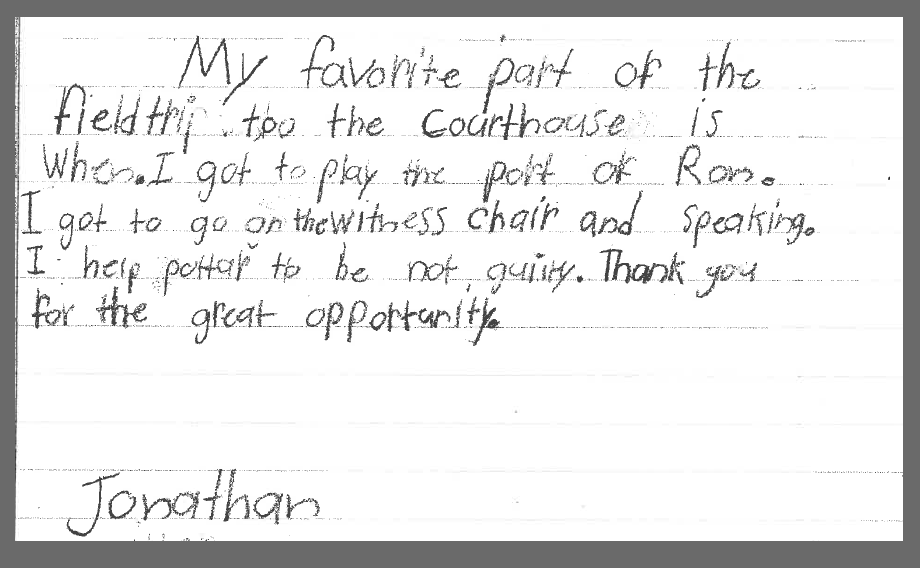
My favorite part of the fieldtrip to the courthouse is when I got to play the part of Ron. I got to go on the witness chair and speaking. I helped Potter to be not guilty. Thank you for the great opportunity.
- Johnathan M [Harmon Elementary - Grade 4]
Project Real
2020-12-16T21:47:04+00:00
My favorite part of the fieldtrip to the courthouse is when I got to play the part of Ron. I got to go on the witness chair and speaking. I helped Potter to be not guilty. Thank you for the great opportunity. - Johnathan M [Harmon Elementary - Grade 4]
Thank you for letting us watch the civil case! It was cool because it was a real case and not one played out. I had a lot of fun watching the other kids act out a session. Thank you for your time.
- Kaylie [Hewetson Elementary - Grade 5]
Project Real
2020-12-11T20:39:35+00:00
Thank you for letting us watch the civil case! It was cool because it was a real case and not one played out. I had a lot of fun watching the other kids act out a session. Thank you for your time. - Kaylie [Hewetson Elementary - Grade 5]